Artificial intelligence is becoming part of everyday business operations, but not every organization uses it in the same way. Some businesses connect AI with their existing software to make data and processes more intelligent, while others use AI to automate repetitive tasks and workflows.
This leads to an important distinction: AI Integration vs AI Automation.
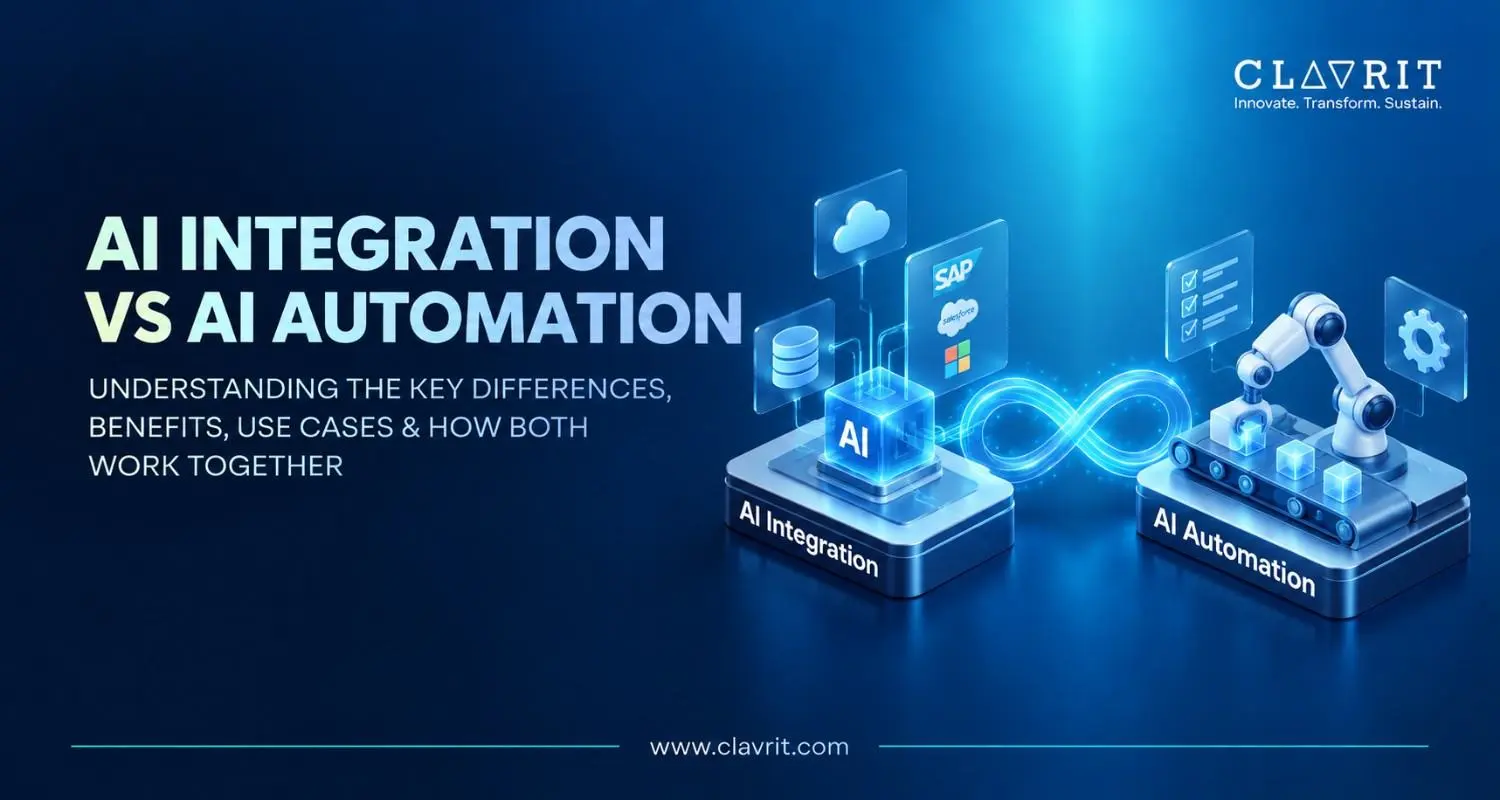
Although the two approaches are closely related, they solve different problems. AI integration focuses on connecting AI capabilities with existing systems, applications, and data. AI automation focuses on using AI to perform tasks or execute workflows with limited manual intervention.
Understanding the difference can help businesses decide where AI can create practical value and how it can fit into their existing technology environment.
What is AI Integration?
AI integration is the process of connecting artificial intelligence capabilities with existing business systems, applications, databases, or workflows.
Instead of using AI as a separate tool, businesses integrate it into the technology they already use. This allows AI to work with existing data and processes.
For example, a company could integrate an AI model into its CRM system to analyse customer interactions and provide relevant insights to sales teams. The CRM remains the primary system, while AI adds additional intelligence to the workflow.
AI integration can involve:
CRM and customer data
Enterprise applications
APIs and AI models
Business intelligence platforms
Communication tools
Internal databases
Customer-facing applications
The objective is to make existing systems more capable without necessarily replacing them.
What is AI Automation?
AI automation uses artificial intelligence to perform tasks or manage workflows that would otherwise require human effort.
Traditional automation generally follows predefined rules. AI automation can add capabilities such as language understanding, pattern recognition, classification, prediction, and content generation.
For example, a business could use AI to classify incoming customer emails, identify their intent, and automatically route them to the appropriate team.
AI automation can be used for:
Data processing
Customer support
Document classification
Email handling
Content generation
Lead qualification
Workflow routing
Reporting
The focus is on reducing manual effort and making processes more efficient.
Difference Between AI Integration and AI Automation
The simplest way to understand the difference is to look at what each approach is designed to do.
AI Integration | AI Automation |
| Connects AI with existing systems | Uses AI to perform tasks or workflows |
| Focuses on adding intelligence | Focuses on reducing manual work |
| Works within existing technology environments | Executes defined processes with less human intervention |
| Can provide insights and recommendations | Can trigger actions based on inputs |
| Often requires system and API integration | Often requires workflow and process design |
The two are not competing technologies. In many business environments, they work together.
For example, an AI model can be integrated into a CRM, and automation can then use its output to qualify leads or trigger follow-up actions.
AI Integration vs AI Automation: Key Benefits
Both approaches can improve business processes, but their benefits differ.
Benefits of AI Integration
AI integration can help businesses:
Add AI capabilities to existing software
Use existing business data more effectively
Improve decision support
Reduce the need for disconnected AI tools
Create more intelligent customer and employee experiences
Benefits of AI Automation
AI automation can help businesses:
Reduce repetitive manual work
Speed up routine processes
Improve workflow consistency
Handle larger volumes of tasks
Allow employees to focus on higher-value activities
The right approach depends on whether the primary requirement is adding intelligence to an existing system, automating a process, or both.
AI Integration Examples
AI integration can take many forms depending on the organization's technology environment.
CRM integration
AI can be integrated into a CRM to analyse customer interactions, summarize records, generate content, or provide sales insights.
Customer service integration
AI capabilities can be connected with customer service platforms to assist agents with case summaries, response generation, and knowledge retrieval.
Business intelligence integration
AI can work with business intelligence systems to help users interpret data, identify patterns, or generate natural-language summaries.
Enterprise application integration
Organizations can connect AI models with internal applications through APIs, allowing existing systems to access AI-powered capabilities without completely changing their underlying architecture.
AI Automation Examples
AI automation focuses more directly on performing tasks.
Automated customer support
AI can understand customer questions, identify intent, and provide responses to common requests.
Lead qualification
AI can analyse lead information and interactions to categorize or prioritize leads according to predefined business criteria.
Document processing
AI can extract information from invoices, forms, contracts, and other documents, reducing manual data entry.
Email classification
AI can classify incoming emails based on topics, intent, or urgency and route them to the appropriate workflow or team.
AI Integration and Automation Use Cases
Businesses often use both approaches across different departments.Business function | AI Integration | AI Automation |
| Sales | AI insights within CRM | Automated lead qualification |
| Customer service | AI-assisted agent workspace | Automated query handling |
| Finance | AI analysis within financial systems | Invoice data extraction |
| Marketing | AI connected to customer data | Automated content workflows |
| HR | AI insights within HR systems | Candidate or document screening |
| Operations | AI connected to business applications | Automated task routing |
This demonstrates why AI integration vs AI automation should not always be viewed as an either-or decision. The two can address different stages of the same business process.
How AI Integration Works With Existing Systems
Businesses usually integrate AI through APIs, connectors, software development kits, or platform-specific integrations.
A typical process may include:
Existing system → API or integration layer → AI model/service → AI output → Existing workflow
For example, a CRM could send selected customer information to an AI service, receive a generated summary, and display that summary within the CRM interface.
Before implementation, organizations should consider data access, security, compatibility, scalability, and governance.
The goal should be to make AI work with existing processes rather than creating another isolated technology environment.
How AI Automation Works
AI automation generally begins by identifying a task or workflow that requires repetitive human effort.
The process can then be structured as:
Input → AI analysis → Decision or generation → Action → Review
For example, when a customer email arrives, AI can analyse the message, identify its category, generate an appropriate response, and route or send the response according to the organization's workflow.
Not every process should be fully automated. Tasks involving sensitive information, complex decisions, or significant business consequences may still require human review.
AI Integration vs Automation: Which Approach to Choose?
The decision should start with the business problem rather than the technology.
Consider AI integration when:
You already have a system that needs additional intelligence.
Employees need AI-generated insights within existing workflows.
You want to connect AI with existing business data.
Replacing the current system is unnecessary.
Consider AI automation when:
A process involves repetitive manual tasks.
Rules and outcomes can be clearly defined.
The organization wants to reduce processing time.
High volumes make manual handling inefficient.
If the requirement involves both intelligent decision-making and automated action, combining the two may be more appropriate.
Combining AI Integration and Automation
AI integration and automation can work together to create more connected workflows.
Consider a customer service process. AI could first be integrated into the CRM to understand customer history and previous interactions. An automation workflow could then use that information to categorize the request, generate a response, and route complex cases to an employee.
The resulting workflow could look like:
CRM data → AI analysis → Automated action → Human review when required
This approach allows organizations to keep their existing systems while using AI to improve specific parts of the process.
Future of AI Integration and Automation
AI integration and automation are likely to become increasingly connected as businesses adopt AI across their technology environments.
Rather than adding standalone AI tools for individual tasks, organizations may increasingly connect AI capabilities directly with CRM, ERP, customer service, analytics, and other enterprise systems.
At the same time, automation can extend beyond simple rule-based workflows. AI can help systems interpret unstructured information and respond to changing inputs, while human employees remain involved where judgment and accountability are important.
The future is therefore less about choosing between integration and automation and more about determining where intelligence and automation can work together effectively.
Final Thoughts
The difference between AI integration vs AI automation comes down to their primary purpose. AI integration connects artificial intelligence with existing systems to add intelligence and capabilities, while AI automation uses AI to perform tasks and streamline workflows.
Businesses do not necessarily have to choose one approach.
Integrating AI into existing systems can provide employees with better insights and capabilities, while automation can reduce repetitive work and improve process efficiency. When combined thoughtfully, the two approaches can help organizations build more connected and intelligent workflows.
The most effective strategy is to begin with a clear business problem, assess existing systems and processes, and then determine where AI integration, automation, or a combination of both can provide measurable value.
Suggested Reads:
Salesforce Einstein AI Features in 2026
RAG vs Fine-Tuning: Which AI Strategy Works Best for Enterprise?
FAQ’s
1. What is AI integration?
AI integration is the process of connecting artificial intelligence capabilities with existing business systems, applications, data, or workflows to add AI-powered functionality.
2. What is AI automation?
AI automation uses artificial intelligence to perform tasks, make classifications, generate content, or execute parts of a workflow with reduced manual intervention.
3. Is AI integration the same as AI automation?
No. AI integration focuses on connecting AI with existing systems, while AI automation focuses on using AI to perform tasks or automate workflows. They can also be used together.
4. What is the difference between AI integration and automation?
AI integration primarily adds AI capabilities to existing technology, while AI automation uses those capabilities to reduce manual work and execute processes more efficiently.
5. What are examples of AI integration?
Examples include integrating AI with CRM systems, customer service platforms, business intelligence tools, enterprise applications, and internal databases to provide insights, summaries, recommendations, or content generation.
6. What are examples of AI automation?
Examples include automated customer support, lead qualification, document processing, email classification, data extraction, and automated workflow routing.
7. Can AI integration and automation work together?
Yes. AI can be integrated into an existing business system and then used by automated workflows. For example, an AI-enabled CRM can analyse customer information while automation uses the results to trigger follow-ups or route cases.
8. How much does AI integration cost?
The cost varies depending on the AI technology, existing systems, integration complexity, data requirements, development effort, and scale of deployment. A simple API integration may require significantly less investment than a complex enterprise implementation.
9. How much does AI automation cost?
AI automation costs depend on the number and complexity of workflows, AI models or platforms used, integration requirements, data volume, and ongoing maintenance. Businesses should evaluate the expected time savings and operational benefits alongside implementation costs.