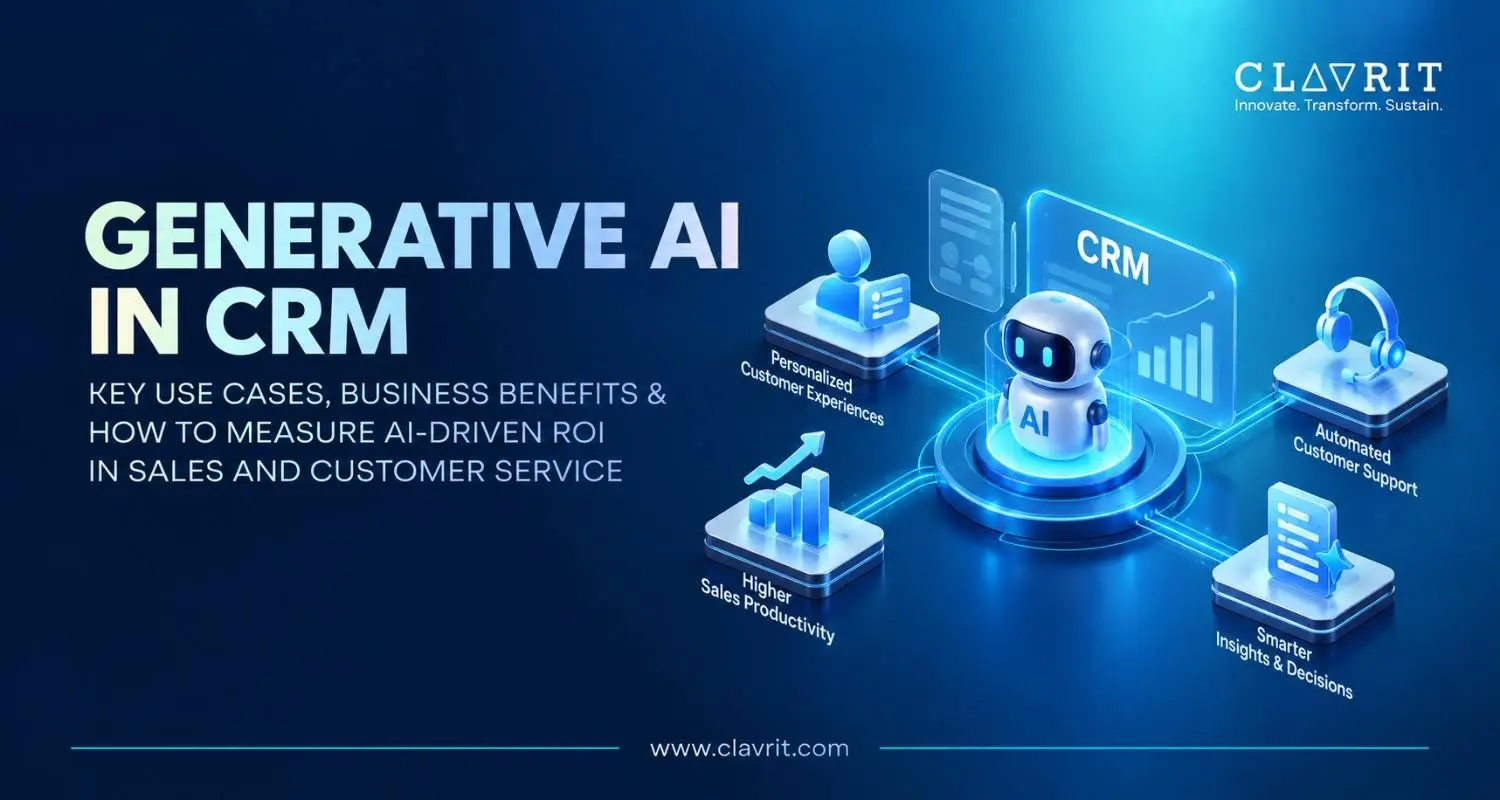
Customer relationship management has always been about understanding customers and acting on that information. But as customer interactions grow across email, chat, calls, social media, and digital channels, CRM teams are dealing with more data and more repetitive work than ever.
This is where Generative AI in CRM is changing how sales, marketing, and customer service teams work.
Unlike traditional CRM automation, which follows predefined rules, generative AI can create content, summarize information, interpret conversations, and assist employees using natural language. When connected to CRM data, it can help teams spend less time searching for information and more time acting on it.
Salesforce, for example, uses generative AI capabilities across sales and service workflows, including personalized sales emails, customer summaries, service replies, and knowledge-related tasks.
The real question for businesses is no longer whether AI can work with CRM data. It is where it can create measurable business value and how organizations can calculate the ROI.
What Is Generative AI in CRM?
Generative AI in CRM refers to the use of large language models and related AI technologies to generate, summarize, analyze, or assist with customer-related information within a CRM environment.
Traditional CRM systems primarily store and organize information. Generative AI can help employees interact with that information using natural language.
For example, instead of manually reviewing a long customer history, a sales representative could ask an AI assistant to summarize recent interactions, identify open issues, or prepare an email based on the account context.
This creates a shift from CRM as a system of record to CRM as an intelligent work environment.
How Does Generative AI Work With CRM Data?
Generative AI becomes more useful when its responses are connected to relevant business and customer data rather than relying only on general-purpose information.
A typical workflow can look like:
CRM data → AI retrieves relevant context → AI generates or summarizes information → Employee reviews → Action is taken
For example, Salesforce's generative AI capabilities can use CRM information to create personalized sales emails, while its service capabilities can generate replies based on conversation context and relevant knowledge.
The human review stage remains important, particularly when AI-generated content influences customer communication or business decisions.
Key Generative AI CRM Use Cases
Generative AI can support multiple stages of the customer lifecycle. The most practical use cases tend to focus on repetitive work, information retrieval, content generation, and customer interaction.
1. Personalized Sales Emails
Sales representatives spend significant time writing follow-up emails, introductions, meeting recaps, and other communications.
Generative AI can create a first draft using relevant CRM information, allowing the salesperson to review and personalize it before sending.
Salesforce's Einstein Generative AI for Sales, for example, can generate personalized emails for contacts and leads using Salesforce data as context.
2. Sales Call and Meeting Summaries
Sales conversations can contain important details about customer requirements, objections, next steps, and timelines.
Instead of asking sales representatives to manually document everything, AI can help summarize conversations and highlight relevant actions. This makes it easier for teams to maintain consistent CRM records.
3. Account and Opportunity Summaries
Large accounts can have years of interactions across different teams. Reviewing that information manually before every meeting is inefficient.
AI can summarize account history, recent interactions, opportunities, and relevant activities so sales representatives can prepare more quickly.
Salesforce's AI use cases include client meeting preparation, opportunity optimization, and account planning.
4. Customer Service Responses
Customer service representatives often answer similar questions repeatedly. Generative AI can draft responses based on the conversation and available business knowledge.
Salesforce's Service Replies, for example, uses generative AI to draft relevant responses for service representatives during chat, messaging, or case emails.
The representative can then review the suggested response before sending it.
5. Case Summarization
Support cases can involve multiple messages, internal notes, and previous interactions. AI-generated summaries can help representatives quickly understand what happened without reading the entire history.
Salesforce also identifies conversation and case summaries as service AI use cases.
6. Knowledge Creation
Customer service teams repeatedly encounter questions that could become useful knowledge articles.
Generative AI can help draft knowledge content from resolved cases, which employees can then review and approve. This can make useful information easier to reuse across the support organization.
Generative AI for Sales and Customer Service
Sales and service teams benefit from generative AI in different ways.
Sales | Customer Service |
| Generate personalized emails | Draft customer responses |
| Summarize accounts | Summarize cases |
| Prepare for meetings | Summarize conversations |
| Support opportunity management | Recommend relevant knowledge |
| Create follow-up content | Assist with case wrap-up |
| Identify next actions | Support faster issue resolution |
The common benefit is reducing repetitive administrative work while keeping employees involved in customer-facing decisions.
Salesforce describes its AI capabilities as supporting sales productivity through recommendations, automation, and AI-generated content, while its service tools provide real-time assistance and recommendations to service representatives.
Benefits of Generative AI in CRM
The value of generative AI goes beyond simply producing text faster.
Higher employee productivity
Sales representatives and service agents can spend less time searching for information, documenting interactions, and creating repetitive content.
Faster customer responses
AI-generated drafts and summaries can reduce the time required to understand a customer issue and prepare a response.
More consistent communication
Organizations can use approved knowledge and CRM context to help employees create responses that follow established information and communication standards.
Better access to customer context
Instead of navigating multiple records, employees can use AI to summarize relevant customer information in a more accessible format.
Greater scalability
As customer interactions increase, AI can help teams manage repetitive workloads without requiring every task to be completed manually.
How to Measure the ROI of Generative AI in CRM
Implementing AI is an investment, so organizations need to measure more than the number of AI-generated emails or summaries.
A practical ROI framework should connect AI adoption to measurable operational and business outcomes.
Metric | What to measure |
| Time saved | Reduction in time spent on repetitive CRM tasks |
| Response time | Change in customer response or resolution time |
| Productivity | Number of cases, leads, or activities handled per employee |
| Conversion rate | Change in sales conversion after AI adoption |
| Customer satisfaction | Changes in CSAT or related service metrics |
| Cost efficiency | Operational cost saved through productivity improvements |
| Adoption | Percentage of employees regularly using AI features |
For example, if an AI assistant saves each service representative 30 minutes per day, the organization can calculate the total hours saved across the team and compare that value with the cost of implementation.
However, ROI should not be based only on time savings. Faster responses, better customer experiences, improved sales productivity, and more consistent data can also contribute to the overall business case.
What Are the Challenges of Generative AI in CRM?
Generative AI is powerful, but implementation requires careful planning.
Data quality
AI outputs depend heavily on the information available to the system. Incomplete, outdated, or inconsistent CRM data can reduce the usefulness of generated responses.
Accuracy
AI can produce incorrect information. Customer-facing outputs should therefore be reviewed according to the risk and use case.
Data privacy
CRM systems contain sensitive customer and business information. Organizations need appropriate security, access controls, and governance before connecting AI to customer data.
Employee adoption
Technology only creates value when employees actually use it. Teams need clear workflows, training, and guidelines around when AI should and should not be used.
How to Implement Generative AI in CRM
Businesses do not need to automate every CRM workflow at once. A focused rollout is often more practical.
Start with repetitive tasks. Identify activities such as email drafting, case summaries, or meeting preparation that consume significant employee time.
Choose measurable use cases. Define the baseline before implementation so improvements can be evaluated later.
Connect AI to trusted data. The quality and relevance of CRM information directly affect the usefulness of AI-generated outputs.
Keep humans in the loop. Employees should review important customer-facing content and decisions where appropriate.
Measure and improve. Track productivity, response times, adoption, quality, and customer outcomes after deployment.
Building an AI-Powered CRM Strategy
Generative AI should not be treated as a standalone feature added to an existing CRM system. Its value comes from how well it fits into existing customer and employee workflows.
Organizations should consider three areas:
Data: Is the CRM data accurate, accessible, and properly governed?
Process: Which workflows can benefit from AI without adding unnecessary complexity?
People: Are employees prepared to use AI effectively and review its outputs?
For businesses evaluating Salesforce, integrating AI capabilities with a broader Salesforce Service Cloud environment can help connect customer information, service workflows, knowledge, and AI-assisted experiences. Salesforce's current Service Cloud offering includes AI-supported service capabilities such as Service Replies and real-time assistance for service representatives.
How Clavrit Can Help
Implementing an AI-powered CRM requires more than activating an AI feature. Businesses need to evaluate their existing CRM architecture, customer data, workflows, integrations, and governance requirements.
Clavrit helps businesses work with Salesforce solutions to build and optimize CRM environments around their business requirements. Its approach can involve understanding existing processes, identifying relevant AI use cases, integrating CRM data, and supporting the adoption of AI-enabled workflows.
The objective is to ensure that generative AI supports real business processes rather than becoming another disconnected technology layer.
Conclusion
Generative AI is changing how businesses use CRM systems by helping teams summarize customer information, generate relevant content, automate repetitive tasks, and respond to customers with greater context. The most effective approach is to start with practical use cases, maintain strong data governance, and measure outcomes such as productivity, response time, customer satisfaction, and operational efficiency.
For businesses looking to strengthen their CRM ecosystem, the right Salesforce strategy can provide the foundation for integrating AI into sales and customer service workflows. Explore Clavrit’s Salesforce solutions to understand how Salesforce can support your organization's evolving CRM and customer experience needs.
FAQ’s
Q1. What is Generative AI in CRM?
Generative AI in CRM uses AI and large language models to generate, summarize, and analyze customer-related information within CRM workflows. It can assist with tasks such as email generation, case summaries, customer responses, and sales preparation.
Q2. What are the main Generative AI CRM use cases?
Common use cases include personalized sales emails, meeting summaries, account summaries, customer service responses, case summarization, knowledge creation, and workflow assistance.
Q3. How does Generative AI benefit sales teams?
It can reduce time spent on repetitive tasks such as drafting emails, preparing for meetings, summarizing customer interactions, and documenting follow-ups. This can allow sales representatives to spend more time on customer engagement.
Q4. How can Generative AI improve customer service?
Generative AI can help service representatives understand customer history, summarize cases, recommend relevant information, and draft responses. Salesforce provides capabilities such as Service Replies and case or conversation summaries for these types of workflows.
Q5. How do you measure the ROI of Generative AI in CRM?
ROI can be measured through time saved, employee productivity, response times, conversion rates, customer satisfaction, operational costs, and AI adoption. Organizations should establish baseline measurements before implementation.
Q6. Is Generative AI safe to use with CRM data?
It can be used responsibly when organizations implement appropriate data governance, security, access controls, and review processes. Businesses should evaluate how customer data is accessed, processed, stored, and used by each AI capability before deployment.