Digital transformation has become an important priority for enterprises looking to improve operational efficiency, enhance customer experiences, and remain competitive in changing markets. However, adopting new technology alone does not guarantee meaningful business improvement. Organisations must also rethink their processes, systems, and strategies to achieve lasting results.
This is where digital transformation services come into play. These services help businesses assess their existing technology landscape, identify opportunities for improvement, implement digital solutions, and align technology investments with business objectives.
From cloud migration and enterprise application modernisation to artificial intelligence and workflow automation, digital transformation services cover a wide range of initiatives. The right approach depends on an organisation's current challenges, long-term goals, and digital maturity.
In this guide, we explore what digital transformation services are, how they work, real-world enterprise examples, commonly used frameworks, key benefits, and the challenges businesses should prepare for.
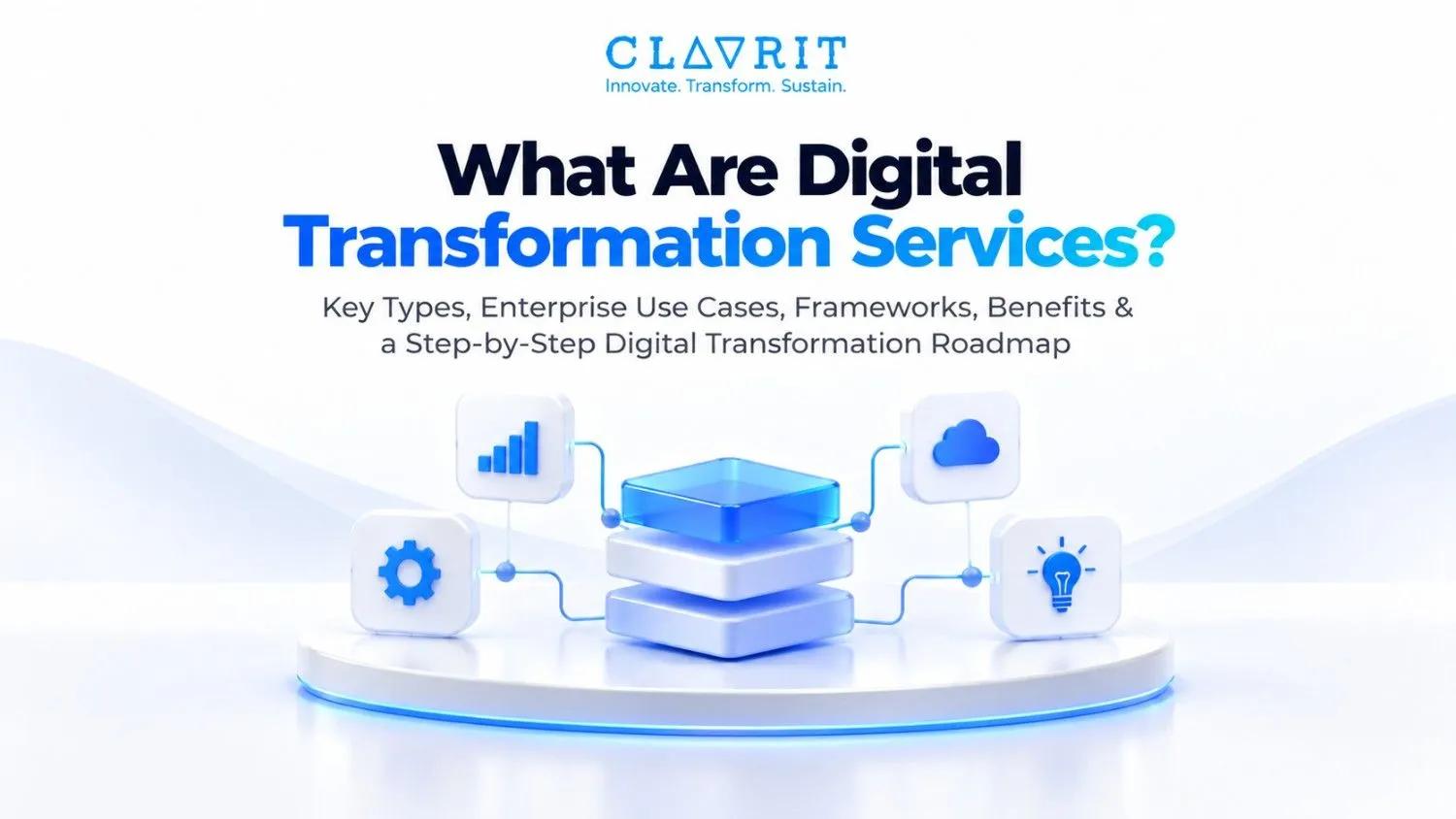
What Are Digital Transformation Services?
Digital transformation services are professional services that help organisations use digital technologies to improve business processes, modernise systems, and create new ways of delivering value to customers.
These services can include technology consulting, cloud adoption, enterprise software implementation, data analytics, AI integration, process automation, cybersecurity improvements, and ongoing digital optimisation.
Unlike isolated IT projects, digital transformation initiatives typically focus on broader business outcomes. For example, implementing a cloud platform may improve infrastructure flexibility, while redesigning customer service workflows can reduce response times and improve customer satisfaction.
A successful transformation considers three interconnected areas:
Technology: Modernising applications, infrastructure, data platforms, and digital tools.
Processes: Improving workflows, reducing manual tasks, and removing operational bottlenecks.
People and culture: Helping employees adopt new systems, develop digital skills, and adapt to changing ways of working.
The objective is to ensure that technology investments support measurable business improvements rather than simply adding more tools to an organisation's existing environment.
Types of Digital Transformation Services
Digital transformation services can address different business needs depending on an organisation's priorities.
1. Digital Strategy and Consulting
Digital transformation consulting helps enterprises understand their current capabilities, define business objectives, and establish a roadmap for change.
Consultants may assess existing applications, identify process inefficiencies, evaluate technology options, and prioritise initiatives according to their expected business value.
A well-defined strategy also helps organisations avoid investing in technologies that do not address their actual operational challenges.
2. Cloud Migration and Modernisation
Cloud transformation involves moving applications, infrastructure, or workloads to cloud environments and modernising them where appropriate.
Depending on business requirements, organisations may adopt public, private, or hybrid cloud architectures.
Cloud services can support scalability, improve infrastructure flexibility, and reduce the need to manage certain on-premises resources. However, businesses must also consider migration complexity, security, compliance, and ongoing cloud costs.
3. Enterprise Application Modernisation
Many organisations rely on legacy applications that are difficult to maintain or integrate with newer systems.
Application modernisation services help businesses upgrade, replace, or restructure these systems to improve performance and maintainability.
Examples include modernising SAP environments, integrating Salesforce with enterprise applications, and connecting previously disconnected business systems.
The appropriate approach depends on the existing technology landscape and the level of change required.
4. Data Analytics and Artificial Intelligence
Data and AI services help organisations convert business information into actionable insights and automate selected activities.
Applications may include demand forecasting, customer segmentation, predictive maintenance, intelligent document processing, and decision-support systems.
Successful implementation requires reliable data, appropriate governance, and clear business use cases. AI adoption should also account for accuracy, security, transparency, and human oversight where necessary.
5. Business Process Automation
Process automation helps organisations reduce repetitive manual work and improve consistency across business operations.
Examples include automated invoice processing, employee onboarding workflows, customer support routing, and sales reporting.
Automation is most effective when businesses first understand and improve the underlying process. Automating a poorly designed workflow can reproduce existing inefficiencies rather than eliminate them.
6. Digital Customer Experience
Customer experience transformation focuses on making interactions simpler, more consistent, and more relevant across digital channels.
Services may include website modernisation, e-commerce implementation, CRM integration, customer portals, and omnichannel service design.
For example, integrating a CRM platform with order-management systems can help customer service teams access relevant order information without repeatedly switching between applications.
Key Benefits of Digital Transformation Services for Enterprises
Digital transformation can deliver several benefits when initiatives are aligned with business priorities and implemented effectively.
Improved Operational Efficiency
Modern systems and automated workflows can reduce repetitive tasks, minimise manual errors, and shorten process cycles.
Employees can spend less time transferring information between applications and more time on activities requiring judgement, collaboration, and problem-solving.
Better Customer Experiences
Connected systems help businesses maintain more consistent customer information across sales, marketing, and service teams.
This can support faster responses, more personalised interactions, and smoother customer journeys.
More Informed Decision-Making
Digital transformation can improve access to operational and customer data.
Dashboards, analytics platforms, and forecasting tools help decision-makers identify trends, monitor performance, and respond to changing business conditions.
The value of these capabilities depends on data quality and whether employees can interpret and use the available insights effectively.
Greater Business Agility
Modern technology architectures can make it easier to introduce new applications, adapt workflows, and respond to changing requirements.
Cloud infrastructure, modular applications, and well-designed integrations can help enterprises evolve without rebuilding their entire technology environment for every new initiative.
Stronger Integration Across Departments
When enterprise systems operate independently, teams may work with conflicting information or rely on manual coordination.
Integration services help connect relevant data and workflows across departments, supporting more consistent business operations.
Support for Innovation and Growth
A modern digital foundation can make it easier to test new services, introduce digital products, and explore emerging technologies.
However, innovation depends on more than technology. Organisations also need suitable processes, skilled employees, and leadership support to turn new capabilities into business value.
Digital Transformation Examples and Enterprise Use Cases
Digital transformation looks different across industries and business functions. The following examples illustrate how enterprises can apply digital capabilities to practical challenges.
Example 1: Connecting Enterprise Systems
Business challenge: Sales, finance, and operations teams maintain separate records and frequently exchange information manually.
Transformation approach: Integrate enterprise resource planning (ERP) systems with customer relationship management (CRM) applications.
Expected outcome: Relevant customer, order, and operational information becomes easier to access across departments, reducing unnecessary handoffs and improving process visibility.
For example, integrating SAP with Salesforce can connect customer-facing sales activities with relevant order-processing and fulfilment workflows.
Example 2: Modernising Legacy Infrastructure
Business challenge: An organisation operates older applications that are expensive to maintain and difficult to scale.
Transformation approach: Assess the application landscape, migrate suitable workloads to cloud infrastructure, and modernise systems according to business requirements.
Expected outcome: The organisation may gain greater infrastructure flexibility, improve maintainability, and establish a stronger foundation for future technology initiatives.
The results depend on migration planning, application architecture, and ongoing cost management.
Example 3: Automating Business Operations
Business challenge: Employees spend significant time processing documents, updating records, and preparing routine reports.
Transformation approach: Introduce workflow automation, system integrations, and appropriate AI-assisted processing.
Expected outcome: Reduced repetitive work, improved process consistency, and faster completion of selected tasks.
Businesses should establish baseline performance metrics before implementation so that improvements can be measured accurately.
Example 4: Improving Digital Commerce
Business challenge: Customers encounter inconsistent product information, limited order visibility, or disconnected shopping experiences.
Transformation approach: Modernise e-commerce platforms and connect them with inventory, order-management, customer-service, and enterprise systems.
Expected outcome: More consistent digital experiences and better coordination between customer-facing and back-office operations.
For enterprise commerce environments, implementation planning should address product data, integration architecture, performance, security, and ongoing platform maintenance.
These are illustrative enterprise use cases, not claims about measured results from specific companies.
Digital Transformation Frameworks Compared
A digital transformation framework provides a structured way to assess capabilities, prioritise initiatives, and manage organisational change.
No single framework is appropriate for every enterprise. The choice depends on business objectives, organisational maturity, and the scope of transformation.
1. McKinsey's Digital Transformation Approach
McKinsey's published work on digital transformation emphasises areas such as strategy, talent, operating models, technology, data, and organisational adoption.
Best suited for: Enterprises undertaking broad business transformation that requires coordination across multiple departments.
Key consideration: Organisations need strong leadership alignment and clear priorities to translate strategic ambitions into execution.
2. MIT Center for Information Systems Research (CISR) Frameworks
MIT CISR research explores how organisations develop digital capabilities and operating models to deliver value through digital technologies.
Its work includes concepts such as digital business models, operating models, and enterprise-wide digital capabilities.
Best suited for: Enterprises seeking to rethink how their operating models and business capabilities support digital growth.
Key consideration: The organisation must understand how changes to its operating model affect governance, processes, and customer value.
3. Microsoft Cloud Adoption Framework
Microsoft's Cloud Adoption Framework provides guidance for planning and managing cloud adoption. Its guidance covers areas such as strategy, planning, readiness, adoption, governance, security, and management.
Best suited for: Organisations planning cloud adoption or modernising workloads within Microsoft cloud environments.
Key consideration: Cloud adoption must include governance, security, operational management, and cost controls rather than focusing only on migration.
4. A Business-Led Digital Transformation Roadmap
Some organisations develop a tailored framework around their business objectives rather than adopting a single external model.
This approach typically includes current-state assessment, goal definition, initiative prioritisation, implementation planning, change management, and performance measurement.
Best suited for: Enterprises with specific business challenges, complex technology landscapes, or transformation requirements that span several frameworks.
Key consideration: The roadmap must be specific enough to guide execution while remaining flexible as business needs evolve.
How Should Enterprises Choose a Framework?
Consider the following factors when selecting a transformation framework:
Evaluation factor | What to consider |
| Business objectives | Does the framework support the outcomes the organisation needs? |
| Digital maturity | Can the organisation realistically adopt the recommended practices? |
| Technology environment | Does the approach fit the existing infrastructure and applications? |
| Organisational readiness | Are leadership, employees, and business teams prepared for change? |
| Governance | Does the framework establish clear responsibilities and decision-making processes? |
| Measurement | Can progress and business outcomes be tracked consistently? |
Enterprises can also combine elements from different frameworks, provided the resulting approach has clear ownership, priorities, and measurable objectives.
Top Digital Transformation Challenges and How to Solve Them
Even well-planned initiatives can encounter difficulties. Recognising common challenges early helps organisations prepare more effectively.
1. Unclear Business Objectives
Without clear objectives, transformation projects can become collections of unrelated technology initiatives.
How to address it: Define the business problem first, establish measurable targets, and prioritise projects according to their expected impact.
2. Legacy Systems and Integration Complexity
Older applications may lack modern interfaces or depend on customised processes that are difficult to replace.
How to address it: Conduct a detailed technology assessment, document system dependencies, and develop a phased modernisation and integration strategy.
3. Poor Data Quality
Inconsistent records, duplicate information, and fragmented data can undermine analytics and automation.
How to address it: Establish data ownership, standardise important fields, implement validation rules, and improve data quality before expanding data-driven initiatives.
4. Resistance to Change
Employees may hesitate to adopt unfamiliar systems, particularly when new workflows affect established responsibilities.
How to address it: Involve employees early, communicate the reasons for change, provide practical training, and collect feedback throughout implementation.
5. Cybersecurity and Compliance Risks
New applications, integrations, and cloud services can introduce additional security and governance requirements.
How to address it: Incorporate security into architecture and implementation decisions. Apply appropriate access controls, monitoring, encryption, and compliance reviews.
6. Difficulty Measuring Return on Investment
Some transformation initiatives deliver benefits over time, making immediate financial returns difficult to assess.
How to address it: Establish baseline measurements, track operational and customer-related indicators, and review benefits throughout the project lifecycle.
Possible indicators include processing time, error rates, system availability, customer satisfaction, and cost per transaction.
How to Build a Digital Transformation Roadmap
A practical roadmap helps enterprises turn their transformation objectives into manageable initiatives.
Step 1: Assess the current state - Review business processes, applications, infrastructure, data quality, and organisational capabilities.
Step 2: Define the desired outcomes - Identify the operational, customer, and strategic improvements the organisation wants to achieve.
Step 3: Prioritise initiatives - Evaluate opportunities according to business value, implementation complexity, cost, risk, and dependencies.
Step 4: Select suitable technologies - Choose platforms and solutions that support the intended outcomes and fit the organisation's existing environment.
Step 5: Implement in phases - Start with manageable initiatives, validate results, and use lessons learned to guide subsequent phases.
Step 6: Measure and improve - Monitor performance indicators, review adoption, address problems, and adjust the roadmap as business requirements change.
This approach reduces the risk of attempting too many changes simultaneously and helps organisations connect technology investments with measurable outcomes.
How Clavrit Supports Digital Transformation
Digital transformation requires more than selecting new technologies. Enterprises must understand their existing systems, identify business priorities, and establish an implementation strategy that supports long-term objectives.
Clavrit Digital Solutions works across enterprise technology and digital solutions, including SAP, Salesforce, AI, and related technology initiatives.
For organisations planning digital transformation, the starting point should be a clear understanding of operational challenges, system dependencies, integration requirements, and desired business outcomes.
A structured approach helps enterprises identify suitable modernisation opportunities, plan implementation activities, and align technology decisions with their broader business strategy.
The appropriate solution will depend on each organisation's current environment, transformation priorities, and long-term goals.
Conclusion
Digital transformation services help enterprises use technology to modernise systems, improve processes, and create better customer and employee experiences.
From cloud migration and enterprise application integration to AI, analytics, and automation, these services address different aspects of business transformation.
However, successful transformation requires more than implementing digital tools. Organisations need clear objectives, reliable data, suitable frameworks, effective change management, and measurable performance indicators.
By understanding their current capabilities and prioritising initiatives according to business value, enterprises can build a practical digital transformation roadmap that supports both immediate improvements and long-term growth.
FAQ’s
1. What are digital transformation services?
Digital transformation services help organisations use digital technologies to improve business processes, modernise systems, enhance customer experiences, and support strategic objectives.
2. What are examples of digital transformation?
Examples include migrating applications to the cloud, integrating ERP and CRM systems, automating business workflows, modernising e-commerce platforms, and implementing data analytics or AI solutions.
3. What are the main benefits of digital transformation services?
Key benefits can include improved operational efficiency, better customer experiences, greater access to business insights, more connected workflows, and increased organisational agility.
4. What are the biggest digital transformation challenges?
Common challenges include unclear objectives, legacy system complexity, poor data quality, employee resistance, security risks, and difficulties measuring return on investment.