Net-zero is no longer only an environmental objective. For enterprises, it is increasingly becoming an operational and technology challenge. Companies need to understand where emissions come from, improve resource efficiency, reduce unnecessary energy consumption, and make sustainability part of everyday business decisions.
Technology can support this transition by giving organizations better visibility into energy use, carbon emissions, supply chains, infrastructure, and operational performance. From AI-powered analytics and automation to cloud modernization and intelligent enterprise software, digital tools can help businesses identify inefficiencies and take measurable action.
For enterprises developing an enterprise technology sustainability net-zero strategy, the objective should not be to adopt technology simply because it is newer or more advanced. The focus should be on using technology to measure impact, improve efficiency, reduce avoidable emissions, and support better long-term decisions.
What Does Net-Zero Mean for Enterprises?
Net-zero means achieving a balance between human-caused greenhouse gas emissions and the removal of an equivalent number of emissions from the atmosphere. The concept therefore involves reducing emissions as far as possible while addressing residual emissions through appropriate removal approaches.
For an enterprise, reaching net-zero can involve several areas of the business, including:
Energy consumption
Buildings and facilities
Manufacturing and production
Transportation and logistics
Supply chains
Data centers and IT infrastructure
Business travel
Waste management
Procurement
Product lifecycle management
The exact priorities depend on the organization's industry, operations, geography, and emissions profile.
Technology becomes important because enterprises cannot effectively improve what they cannot measure or understand.
Why Technology Matters in the Net-Zero Journey
Sustainability initiatives often involve large amounts of operational data. Energy consumption may come from multiple facilities, emissions may be distributed across supply chains, and logistics data may sit in different systems.
Without connected information, organizations can struggle to understand where their largest environmental impacts occur.
Technology can help create a more connected sustainability process:
Collect Data → Analyze Impact → Identify Inefficiencies → Automate Actions → Monitor Results → Improve Continuously
This changes sustainability from an occasional reporting activity into a more continuous management process.
Clavrit's sustainability solutions, for example, use analytics, AI, and digital platforms for areas such as carbon mapping, carbon offset tracking, impact assessment, and sustainability reporting.
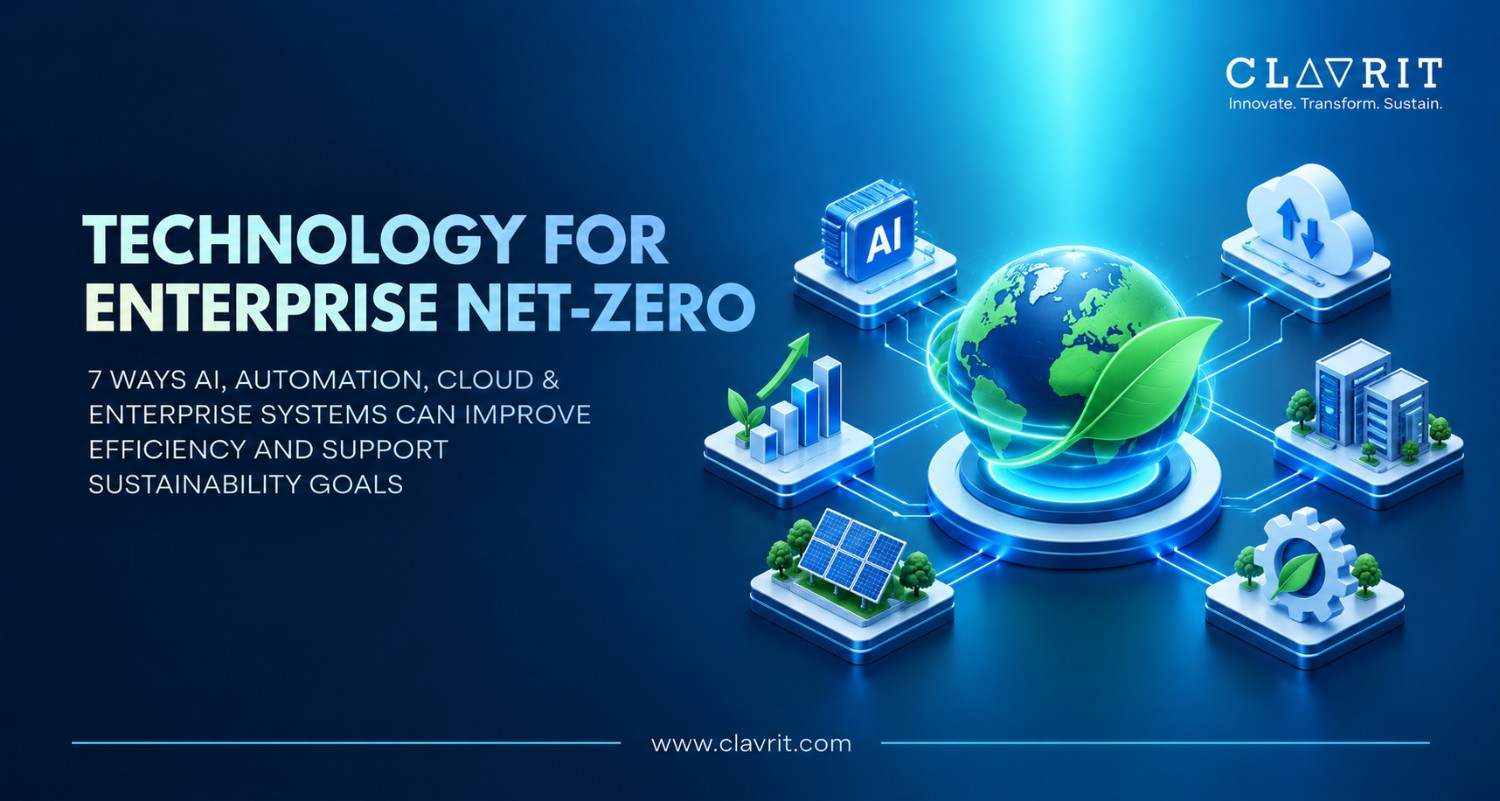
7 Ways Technology Can Support Enterprise Net-Zero Targets

1. Use AI and Analytics to Measure Carbon Impact
One of the first steps toward reducing emissions is understanding where they originate.
AI and analytics can process information from operations, logistics, facilities, supply chains, and other business systems to identify patterns and potential areas for improvement.
For example, businesses can use digital systems to analyze:
Energy consumption
Transportation activity
Production processes
Supply-chain emissions
Equipment performance
Resource utilization
Operational waste
AI integration can make this information more useful by identifying patterns that may not be immediately visible through manual analysis.
Clavrit's sustainability work includes intelligent dashboards and digital platforms designed to turn complex sustainability data into actionable insights.
2. Improve Energy Efficiency Through Intelligent Systems
Energy efficiency is one of the most practical areas where technology can contribute to sustainability.
Organizations can use sensors, connected systems, analytics, and AI to monitor how energy is being consumed and identify inefficient operations.
For example, an intelligent system could help identify:
Equipment operating unnecessarily
Energy consumption outside expected patterns
Inefficient facility operations
Maintenance issues affecting performance
Opportunities to optimize operating schedules
The goal is not simply to collect energy data. It is to use that information to make better operational decisions.
The International Energy Agency identifies energy efficiency and clean technologies as important components of pathways toward net-zero emissions.
3. Optimize Supply Chains and Logistics
Supply chains can represent a significant part of an organization's environmental footprint.
Technology can help enterprises understand transportation patterns, supplier activity, delivery routes, inventory movement, and other operational factors that influence emissions.
For example, digital platforms can help organizations:
Track logistics-related emissions
Identify carbon-intensive activities
Analyze transportation routes
Improve delivery planning
Monitor supplier information
Compare operational scenarios
Clavrit has developed a carbon footprint calculator for eCommerce logistics that integrates shipping data to help retailers monitor and identify carbon-intensive areas of their delivery operations.
This demonstrates how sustainability technology can connect environmental measurement with an existing business process rather than treating sustainability as a separate activity.
4. Use Automation to Reduce Operational Waste
Automation is another important component of an enterprise technology sustainability net-zero strategy.
Manual processes often require repeated data entry, document processing, approvals, reconciliation, and reporting. Automating appropriate workflows can reduce unnecessary manual effort while improving consistency.
AI automation can support areas such as:
Data collection
Sustainability reporting
Monitoring workflows
Equipment alerts
Document processing
Supply-chain processes
Operational approvals
The sustainability benefit depends on the specific process and implementation. Automation itself does not automatically make an operation sustainable. Its value comes from reducing inefficient processes and enabling organizations to use resources more effectively.
Clavrit's AI and sustainability work specifically highlights automation for productivity gains and reducing inefficient workflows.
5. Modernize Cloud and IT Infrastructure
Enterprise technology infrastructure also has a sustainability dimension.
Organizations increasingly rely on cloud platforms, enterprise applications, AI workloads, data pipelines, and large-scale computing infrastructure. As digital workloads increase, businesses need to consider how efficiently these systems use computing resources.
Cloud modernization can help organizations review infrastructure architecture, workload distribution, resource utilization, and application efficiency.
AI workloads require particular attention because large-scale computing can consume significant amounts of electricity. Clavrit's sustainable AI approach includes model optimization, intelligent data processing, and hybrid cloud-and-edge deployment to reduce unnecessary computational and data-transfer requirements.
The principle is straightforward:
More efficient technology infrastructure → Less unnecessary resource consumption → Better operational efficiency
6. Connect Sustainability With Enterprise Systems
Sustainability data becomes more useful when it can be connected with the systems that already run the business.
Enterprise software solutions such as ERP, CRM, analytics, and workflow platforms can provide operational information that helps organizations understand how business decisions affect sustainability.
For example:
Enterprise Area | Technology Contribution |
| Supply Chain | Track logistics and supplier activity |
| Finance | Connect sustainability costs with business decisions |
| Operations | Monitor resource and energy efficiency |
| CRM | Understand customer sustainability requirements |
| Analytics | Identify trends and performance gaps |
| ERP | Connect operational data across business functions |
This is where technologies such as SAP solutions and Salesforce solutions can become part of a broader digital transformation strategy.
Integrating sustainability information with enterprise systems can reduce isolated data and give decision-makers a more complete view of business and environmental performance.
7. Build Sustainability Dashboards for Continuous Monitoring
A sustainability strategy becomes difficult to manage when data is only reviewed periodically.
Digital dashboards can bring relevant indicators into a central view, helping teams monitor changes over time and identify areas that require attention.
Depending on the organization, a sustainability dashboard may track:
Carbon emissions
Energy consumption
Logistics emissions
Resource utilization
Waste
Sustainability targets
Operational efficiency
Progress against internal goals
Clavrit develops intelligent dashboards for sustainability tracking, impact assessment, carbon mapping, and related use cases.
The advantage is visibility. Instead of waiting for a periodic report, teams can use current information to investigate changes and make operational adjustments.
How AI and Sustainability Can Work Together

AI can support sustainability, but it also introduces its own environmental considerations.
Large AI workloads can require significant computing resources, which means enterprises need to consider model efficiency, infrastructure utilization, data movement, and deployment architecture.
A responsible approach therefore looks at both sides:
AI Can Help | AI Must Also Address |
| Optimize operations | Computing requirements |
| Predict equipment issues | Energy consumption |
| Analyze sustainability data | Data-center resource use |
| Improve supply chains | Data movement |
| Automate workflows | Infrastructure efficiency |
| Support forecasting | Responsible deployment |
Clavrit's sustainable AI approach includes model optimization, hybrid cloud and edge deployment, responsible data engineering, automation, and integration with enterprise platforms.
This is an important distinction: using AI for sustainability does not automatically make an AI system sustainable.
How Enterprises Can Build a Technology-Led Net-Zero Strategy
Technology should support a broader sustainability strategy rather than operate as an isolated IT project.
A practical approach can follow these steps:
Step 1: Establish the Baseline
Understand current energy use, emissions, infrastructure, supply-chain activity, and other relevant environmental impacts.
Step 2: Identify High-Impact Areas
Use data and analytics to determine which operational areas have the greatest potential for improvement.
Step 3: Prioritize Technology Use Cases
Focus on practical applications such as carbon tracking, energy optimization, supply-chain analytics, automation, and sustainability reporting.
Step 4: Integrate With Existing Systems
Connect sustainability initiatives with existing enterprise platforms instead of creating disconnected technology environments.
Step 5: Automate Where Appropriate
Use automation to reduce repetitive processes, improve monitoring, and support consistent data collection.
Step 6: Monitor and Improve
Track progress continuously and refine technology solutions as business requirements and sustainability goals evolve.
How Clavrit Supports Enterprise Sustainability
Clavrit combines AI, machine learning, digital engineering, cloud modernization, SAP, Salesforce, and enterprise automation to support technology-led sustainability initiatives. Its sustainability practice includes carbon mapping, carbon offset tracking, impact assessment, intelligent dashboards, and sustainability-focused digital platforms.
Its work also includes practical sustainability use cases. For example, Clavrit has developed technology for logistics carbon tracking and AI-powered dashboards supporting optimization, preventive maintenance, and sustainability monitoring.
This approach connects sustainability with the systems and processes businesses already use, helping organizations move from measurement toward operational improvement.
Conclusion
Technology alone cannot make an enterprise net-zero. But it can provide the visibility, analytics, automation, and infrastructure needed to make sustainability goals more measurable and actionable.
An effective enterprise technology sustainability net-zero strategy can combine AI and analytics with energy efficiency, supply-chain optimization, cloud modernization, automation, and connected enterprise systems.
For enterprises, the future of sustainability is therefore not separate from digital transformation. Technology and sustainability increasingly need to work together.
FAQ’s
Q1. How can technology help enterprises achieve net-zero targets?
Technology can help businesses measure emissions, improve energy efficiency, optimize operations, and monitor sustainability performance.
Q2. What is enterprise technology sustainability?
It means using technology to improve business efficiency while reducing environmental impact through areas such as energy optimization, automation, and carbon tracking.
Q3. How can AI support enterprise sustainability?
AI can analyze sustainability data, identify inefficiencies, forecast demand, and support smarter operational decisions.
Q4. Can automation reduce carbon emissions?
Yes. Automation can improve resource utilization, streamline workflows, and reduce unnecessary operational processes.
Q5. How do enterprise software solutions support sustainability?
They connect operational data across business functions, helping organizations improve visibility, efficiency, and sustainability reporting.
Q6. What should businesses consider when choosing sustainable technology?
Businesses should consider their sustainability goals, existing systems, integration requirements, scalability, and infrastructure efficiency.