Enterprise DevOps transformation is about ending that scene. Not by buying a tool, but by changing how software gets from a developer’s laptop to a customer. At a large organization, that is a much bigger job than it sounds, and it goes wrong in predictable ways. This guide covers what the work involves, what DevOps consulting actually delivers, how to measure where you stand, and a roadmap you can adapt to your own company.
What enterprises DevOps transformation really means
DevOps is a way of working where developers, operations, testing and security share responsibility for what they ship. Repetitive work gets automated. Problems surface early, while they’re still cheap to fix.
A small team can pick that up in a few weeks. An enterprise has hundreds of applications, separate teams with their own tools, audit requirements, vendors, and systems that were built long before anyone said “pipeline.” So “transformation” is the right word. You’re changing habits across many groups at once, and technology is only one part of that.
I’d put it this way. If your teams still hand work to each other through tickets and wait days for answers, installing a CI/CD tool won’t fix much. If they already collaborate well but deploy by hand, the tool will help a lot. The gap between those two situations is exactly what an assessment should find.
Why it’s harder for large organizations
A few things come up in almost every large company.
Every team does it differently. One uses Git properly, another still emails zip files, a third has a build server nobody dares to restart. A change approval board meets weekly, so a one-line fix waits nine days. Security reviews the application right before release, finds problems, and the date slips. Core systems like SAP or other ERP platforms change rarely and carefully, so the rest of the company assumes they can’t be part of the plan.
And often nobody owns the whole path from idea to production. Development owns the code, operations owns the servers, and the delay between them belongs to no one. That is usually where most of the time disappears.
DevOps consulting: assessment and automation
People hear “consulting” and picture slide decks. Good DevOps consulting is closer to a medical check-up followed by a treatment plan, and it has two main parts.
The assessment
A proper assessment looks at how work really moves, which is often different from what the process document says. The consultant picks a few representative applications and traces a change from the moment a developer commits code to the moment a customer can use it. They count the waiting, not just the working.
They also talk to people separately. Developers, testers, operations engineers and security staff will often describe the same release in four different ways, and the differences are the useful part.
Alongside that, they look at your repositories, pipelines, environments, cloud setup and monitoring, and pull a first set of numbers: how often you deploy, how long a change takes, how often a release causes trouble, and how quickly you recover.
What you should get back is short. Here are the two or three things slowing you down most, here’s what to fix first, and here’s what to leave alone for now. If a report comes back with forty equal priorities, it hasn’t made a decision for you.
The automation
Once you know where the time goes, automation starts. Be careful here. Automating a broken process just gives you broken results faster, so sort out the flow first, then automate it.
The usual starting points are fairly consistent:
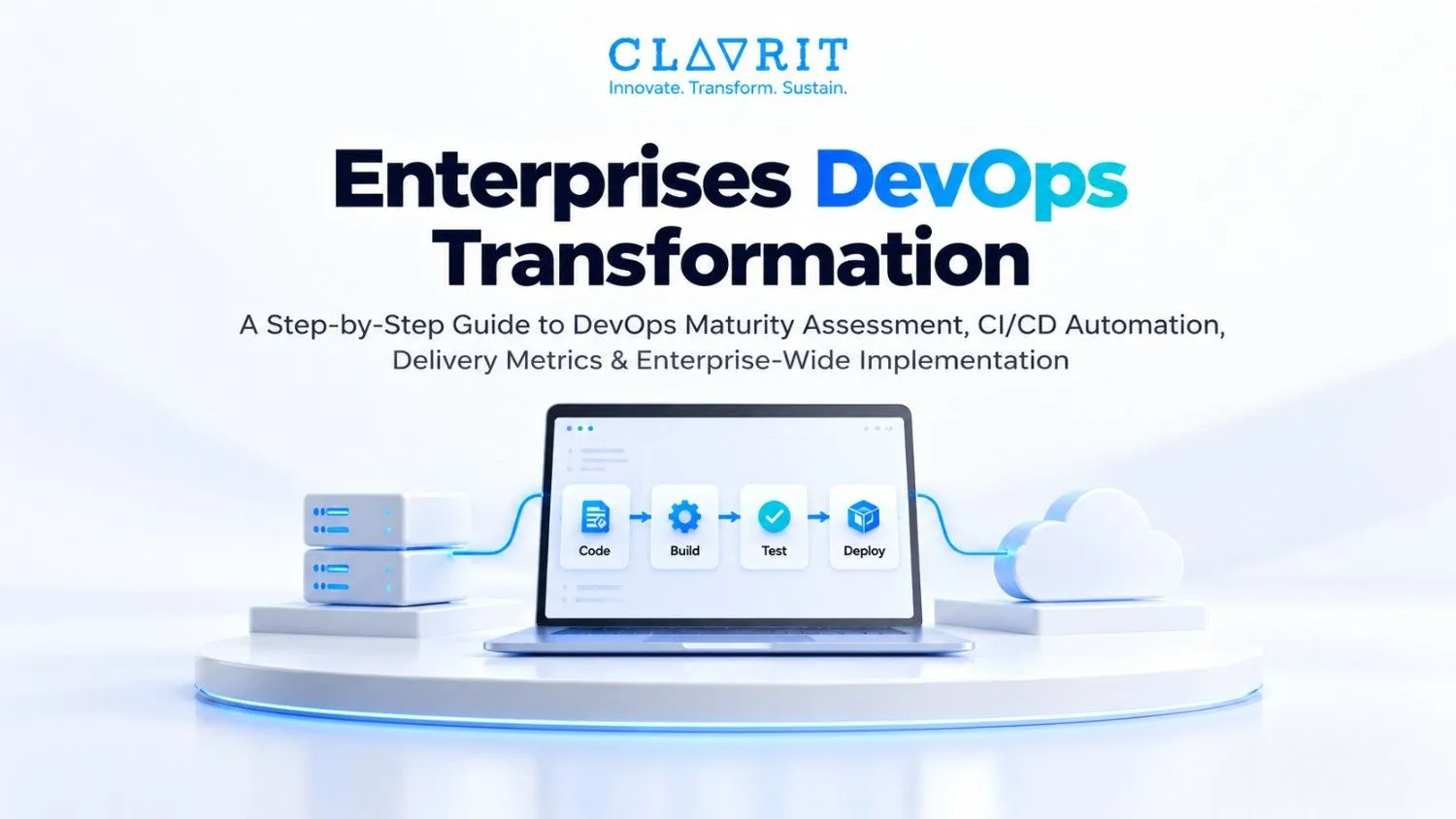
A build and test pipeline that runs on every code change, so nobody wonders whether the latest version still works.
Infrastructure defined in code. Setting up a test environment drops from weeks of tickets to a few minutes, and staging stops drifting away from production.
Automated tests that people actually trust. A suite everyone ignores is worse than none.
Security scans inside the pipeline instead of at the end, which is the idea behind DevSecOps.
Monitoring and alerts good enough that your team hears about a failure before a customer does. If your team can’t cover this around the clock, managed services can take that load while your own engineers stay focused on delivery.
A sensible consultant won’t try to do all of this everywhere at once. They’ll pick one application where the pain is obvious, fix it properly, and let that result do the persuading.
DevOps maturity assessment: how to measure where you stand
Almost every company overestimates its maturity, and that’s not a criticism. When you’re inside a process every day, it’s hard to see how much manual effort has become normal. A maturity assessment gives you something firmer than opinion.
Most models use five levels, with slightly different names.
Level | What it looks like day to day |
| 1 - Initial | Builds and deployments are manual. Releases are rare and stressful, and they depend on a few specific people. |
| 2 - Managed | Some version control and scripts exist, but every team does things its own way. |
| 3 - Defined | Shared pipelines and tools. Processes are documented and mostly followed. |
| 4. Measured | Delivery metrics are tracked and used. Testing and security checks sit inside the pipeline. |
| 5. Optimizing | Teams release on demand, learn from incidents, and keep improving without being told to. |
Here’s the part that surprises leadership. You won’t be at one level. A newer customer-facing app might be at level 4 while the finance system behind it sits at level 1, and both are true at the same time. Score each area separately and you’ll get a map instead of a single grade.
The areas worth scoring are culture and collaboration, source control, build and release automation, testing, environments and infrastructure, security and compliance, and monitoring. For each one, ask a plain question. How much of this is still done by hand, and what happens when the one person who knows it is on leave?
Four numbers to track
The DORA research program popularized four delivery measures that work well as a starting baseline:
Deployment frequency, meaning how often you release to production.
Lead time for changes, meaning how long a change takes from commit to live.
Change failure rate, meaning the share of releases that cause a problem.
Time to restore service, meaning how fast you recover when something breaks.
Capture these before you change anything. If you skip this, you’ll spend a year improving things and have no way to prove it when the budget review arrives.
One warning from experience. Use these numbers to understand systems, not to rank people. The moment a metric turns into someone’s target, it starts getting gamed, and then it tells you nothing.
A DevOps transformation roadmap for large organizations
There’s no single correct sequence, but the order below holds up well in practice.
Tie it to a business goal: “Adopt DevOps” isn’t a goal. “Cut the release time of our customer portal from six weeks to one” is. Pick outcomes that executives already care about, like fewer outages, faster delivery, lower cost, or easier audits.
Assess and set a baseline: Run the maturity assessment and record the four-delivery metrics for a few important applications. Be honest in the write-up. A flattering report feels nice and costs you months.
Get a sponsor and a small core team: Transformations that live only inside IT tend to stall the first time they need a decision from another department. You want a senior sponsor who can settle those disputes, plus a small group from development, operations, security and the business who own the roadmap.
Choose a pilot that matters, but not too much: Pick something visible enough that success gets noticed, and safe enough that a mistake won’t make the news. Skip the internal tool nobody cares about, and skip the system nobody dares touch. Aim for the middle.
Build a foundation you can reuse: For the pilot, set up version control standards, a pipeline, automated tests, infrastructure as code and monitoring. Write down what you learned as you go. The next team shouldn’t start from zero.
Move security and compliance into the pipeline: In regulated industries this step often removes more delay than any other. Work with your compliance team so that evidence is produced automatically as part of each release, rather than gathered by hand afterwards.
Scale in waves: Each wave will be easier on the tooling and harder on the people, because now you’re asking skeptical teams to change. Let people from the pilot coach the next group. A colleague who says “this saved me a weekend” is more convincing than any presentation.
Invest in skills and habits: Training helps, but practice helps more. Pair people across functions. Run incident reviews that ask what failed in the process rather than who failed. Tools change every couple of years. Habits take much longer to build, and to undo.
Review every quarter: Look at the four metrics again, check what moved and what didn’t, and reshuffle the roadmap. Treat it as a working document. If it’s the same in month eighteen as it was in month one, something is wrong
Common Challenges in Enterprises DevOps Transformation
Forming a “DevOps team” that sits between developers and operations. It sounds logical, but it often just rebuilds the wall in a new place. Shared practices matter more than a new org chart box.
Buying tools first. A new platform on top of a broken process gives you a broken process plus a license fee.
Leaving out legacy systems. It’s tempting to modernize only the new applications, but if your order-to-cash flow depends on an older ERP, a large part of your delay probably lives there. It may move slower, but it belongs in the plan.
Ignoring integrations. Many enterprise releases fail between systems, not inside them. Test the connections as seriously as the code.
Calling it done after one good pilot. A pilot is encouraging. It is not a transformation.
How Clavrit can help
Clavrit Digital Solutions was founded in 2019 and works with enterprises across 26+ countries. Our work spans SAP, Salesforce, AI and ML, and enterprise application development.
That mix matters for DevOps work, because a real enterprise release rarely touches only one platform. A single change can involve a cloud application, a Salesforce integration and an SAP back end, and each has its own testing and governance needs. Someone who understands all three will spot problems that a single-tool specialist would miss.
We’d begin by understanding your setup: which applications matter most, where delivery slows down, and what your security and compliance rules require. From there we can help with assessment, a prioritized roadmap, pipeline and automation design, and ongoing support so the improvements don’t fade once the project ends.
If you’re not sure where to begin, a short assessment of your current delivery process is a sensible first step. It gives you facts to plan with, which beats guessing.
Conclusion
Enterprises DevOps transformation is slower and messier than most conference talks make it sound. It’s also one of the most practical investments a large company can make, because every digital business depends on how quickly and safely it can change.
Measure honestly first. Link the work to goals your leadership already cares about. Pick a pilot, build something reusable, and scale one wave at a time, keeping people at the center of the plan. The tools will get replaced eventually. The habits you build are what stay.
If you’re planning a transformation, or restarting one that lost momentum, talk to Clavrit Consultants about assessing your current delivery process.
Frequently asked questions
Q1. What is enterprises DevOps transformation?
It’s the organization-wide adoption of DevOps practices such as shared ownership, automation, continuous delivery and fast feedback, applied across many teams and systems, not just one project.
Q2. What does a DevOps consultant do?
They assess how your software currently gets delivered, find the biggest bottlenecks, design a roadmap, help set up automation like CI/CD pipelines and infrastructure as code, and support teams while they adopt the new practices.
Q3. How do you measure DevOps maturity?
Review practices in areas like source control, release automation, testing, infrastructure, security and monitoring, then pair that with delivery metrics: deployment frequency, lead time for changes, change failure rate and time to restore service.
Q4. How long does a DevOps transformation take?
It depends on size, legacy systems and how ready the organization is. A pilot can show results within a few months. Enterprise-wide change usually takes years and never fully “finishes.”
Q5. Can DevOps work with SAP and other legacy systems?
Yes, though usually at a more careful pace. These systems need stronger change control and integration testing, but version control, automated testing and monitoring still apply.
Q6. Should we start with tools or culture?
Start with goals and process, then pick tools that support them. Tools alone rarely change behavior, and culture change without any tooling support is hard to sustain.