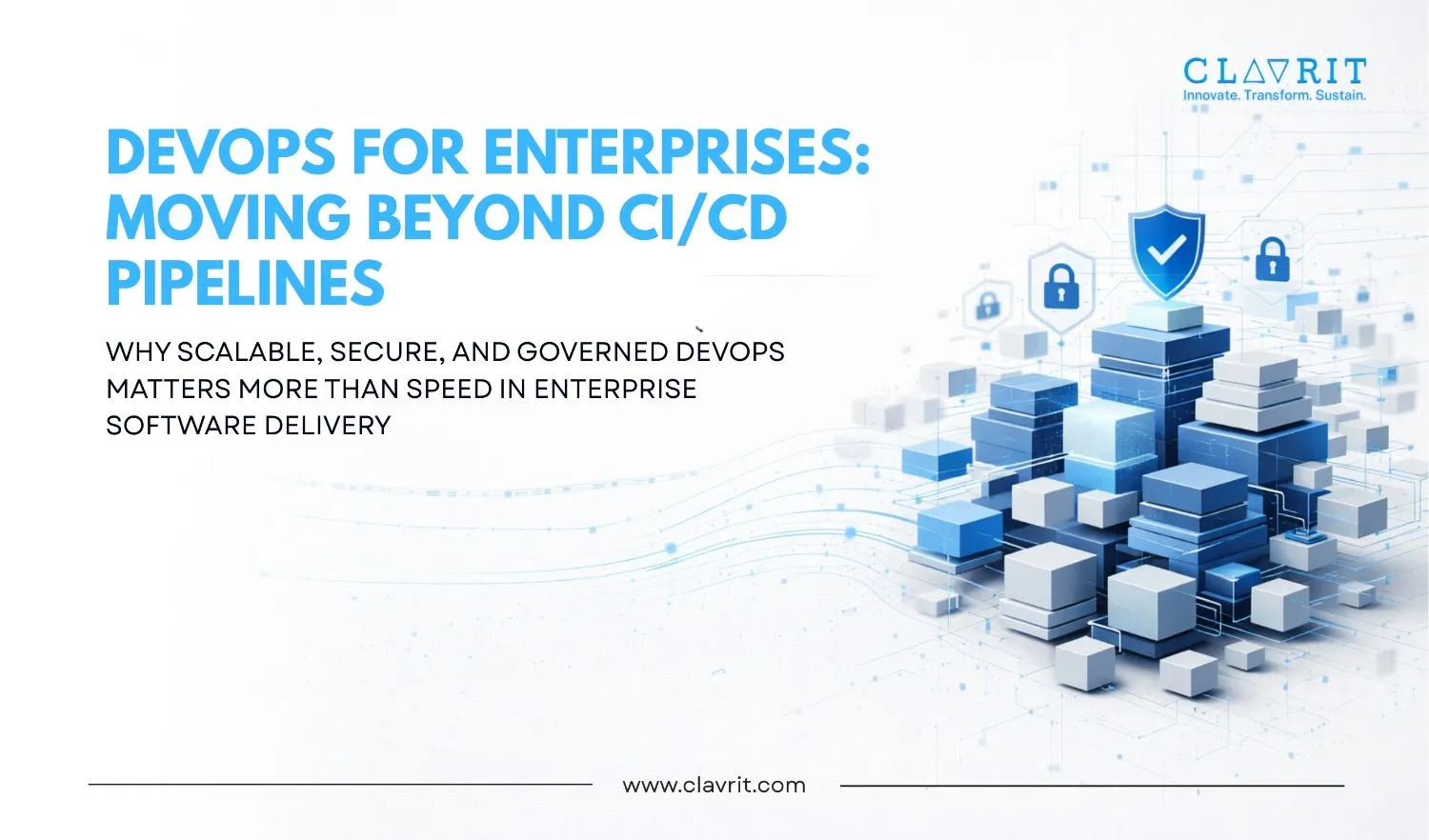
At a majority of organizations implementing DevOps, the focus for an organization starts at CI/CD pipelines and ends here as well. Although CI/CD enables you to automate the process of building, testing, and deploying software with a quicker turnaround timeframe, it does not solve the underlying problems associated with scaling, governance, security, and reliability. Organizations that are large in size run very complex technology environments that have a variety of platforms, multiple teams creating products, regulations to adhere to, and an expectation to operate with high uptime. In these environments, Deploying comes second to strategically planning your approach to running your organization as it relates to software delivery.
Enterprise DevOps is not just about deploying sooner than later. Enterprise DevOps is also about delivering reliable, secure, auditable, and aligned software to the long-term business goals of your organization.
Why CI/CD Pipelines Are Only the Starting Point
Creating Continuous Integration is defined as the continuous process of integrating into one combined software pool (COP) the contributions made by all developers on a team, and providing automated test results to verify each individual change or contribution against the available code base. This means that Continuous Deployment expands the concept of CI by providing Continuous Delivery through leveraging automated systems to deliver validated programs (wherever required) into production environments. As a result, Continuous Deployment permits rapid iteration cycles based on real-time product feedback.
While both practices provide significant advantages to development teams, many enterprises are faced with obstacles that CI/CD by themselves cannot resolve. The lack of integration among the various tools employed by a development team results in a misalignment of standards for product delivery among the different teams under the enterprise. The introduction of governance and compliance processes (manual checkpoints) adds additional delays to the overall delivery timeline. In addition, applying the security controls after the fact increases the level of operational risk to the enterprise. Lack of visibility into distributed systems limits the ability to rapidly diagnose failures. This causes enterprises to increase the frequency of deployment packages without maintaining acceptable standards of product stability, audit-readiness, and cost control.
The disconnect between the objectives of CI/CD being the basis for a complete enterprise DevOps strategy is caused by the need for a CI/CD strategy being incomplete.
Understanding DevOps Maturity in Enterprise Contexts
Organizations use "DevOps maturity models" to assess their level of adoption of DevOps principles. The Waydev maturity model reflects this evolution of enterprise DevOps maturity through the different stages of maturity: from ad-hoc automation to full optimization and data-driven delivery.
As an organization matures, the focus on DevOps changes from an isolated team-based approach (where teams do not share processes or tools) to developing a standard set of processes and tools available to all employees of the organization. The higher an organization goes on the model, the greater the software quality produced by that organization, the shorter the time it takes to recover from incidents, and the greater the level of teamwork and collaboration between developers and operations staff. Ultimately, this proves that DevOps transformation is an organizational function, not solely a tooling use case; therefore, it must develop over time.
Measuring What Matters: DORA Metrics
Standardized performance indicators are essential for businesses to move away from subjective assessments and therefore develop a systematic way of measuring. As a starting point, the DevOps Research and Assessment (DORA) framework establishes four primary objectives or metrics to assist in gauging the effectiveness of DevOps initiatives. These four metrics (Deployment frequency, Lead time for changes, change failure rate, and Mean Time to Recovery (MTTR)) create a composite picture of speed and stability within an organization.
According to the results from Google's DevOps research, organizations that will effectively deploy these 4 key metrics have a much higher chance of achieving their organizational performance goals. Since these metrics are used for creating conversations around the use of tools, and instead of focusing on how tools are used in an organization, they now provide tangible results and impressions as it pertains to how organizations can use DevOps to drive measurable results.
Moving Beyond CI/CD: What Enterprise DevOps Requires
Complete enterprise DevOps encompasses a much larger scope than simply automating pipelines; it also includes creating a complete platform for an organization that includes standardizing platforms, embedding security into the process, providing full observability into the developed product, and enabling the organization to create a structure to govern them as a whole.
By employing a platform engineering approach, an organization can build internal platforms that will minimize or eliminate the complexities of their underlying infrastructure while also providing a means to enforce compliance with developed standards across the entire organization. Instead of waiting for security compliance checks at the end of the development process, deploying DevSecOps allows an organization to include security compliance checks throughout the development lifecycle.
By utilizing observability tools, organizations gain end-to-end visibility into how their system and services behave across a wide range of logging, metrics, and tracing information. This visibility leads to faster resolution of issues and enables better proactive management of issues before they turn into larger, more costly problems.
The combination of these capabilities provides a reliable, scalable operating model for an organization to transform into a resiliency-first approach, rather than continuing to rely on the siloed practices of DevOps.
Enterprise DevOps and Business Outcomes
Research in the industry shows the factual correlation between the maturity of DevOps and expected business outcomes. The mature DevOps practices could lead to faster time-to- market, reliable service delivery, and lower failure rates due to clear automation and
feedback loops. By tracking the right metrics and embedding governance and security upstream, organizations mitigate operational risk and maintain delivery velocity.
Hence, enterprise DevOps should be viewed as an investment for the long run, rather than a temporary efficiency boost.
Enterprise DevOps in Practice: IBM’s Shift Beyond CI/CD
As one of the most well-known examples of Enterprise DevOps transformation, IBM has been on a large-scale transformation journey with nearly every department within the company that builds software.
IBM's pain points were not just related to tools. IBM operates on a sizeable scale and employs thousands of developers and operates on several legacy platforms and has thousands upon thousands of development operations. This resulted in IBM being subject to long development cycles, siloed development practices, and a lack of synergy between development and operations. Although many IBM teams had implemented Continuous Integration Continual Deployment CI/CD pipelines, the inconsistency among teams implementing CI/CD in conjunction with their respective business processes and company culture created bottlenecks with respect to how often developers could deliver new software.
To overcome these challenges, IBM did not just focus on enhancing their tooling (quality and quantity) to deliver high-quality applications and release cycles; rather, they focused on creating a new operating model to deliver the tools to their globally distributed development teams. They reorganized their development teams into Cross-Functional Development Teams with integrated Agile practices and a single standardized CI/CD process across all teams and established a focus on providing their teams with the necessary levels of automation with respect to testing, deploying, and provisioning infrastructure. Although this was a huge component of the transformation process, IBM's most significant focus during their transformation was aligning developers with the applications they develop through their entire journey, from development to production (creating Shared Application Ownership).
As DevOps practices matured, IBM embedded performance measurement into its delivery lifecycle. By focusing on metrics such as deployment frequency, lead time, and recovery time, the company was able to continuously refine its processes and improve reliability alongside speed. According to publicly shared transformation insights, IBM reduced its software delivery cycle time by approximately 75%, while also improving code quality and operational responsiveness (source: https://elitex.systems/blog/devops-transformation).
IBM’s transformation demonstrates a key lesson for enterprises: CI/CD pipelines alone do not deliver DevOps maturity. Sustainable results emerge when automation is combined with organizational restructuring, standardized platforms, continuous measurement, and cultural change. The outcome was not just faster releases, but a more resilient, scalable, and predictable delivery ecosystem aligned with business goals.
How Clavrit Enables Enterprise DevOps Transformation
Clavrit's approach to enterprise DevOps is that of a disciplined transformation effort in alignment with the organization’s desired business outcomes. The Clavrit team uses organizations’ standard metrics, including DORA metrics, to assess their current level of success with DevOps, find the areas where the organization is lacking in the areas of people, processes and platforms, and creates a way for an organization to build a scalable DevOps operating model.
Clavrit utilizes the following elements as part of their overall approach: Creating Generalized but Continuous Integration/Continuous Delivery Ecosystems; Building DevSecOps & Compliance within the CI/CD Pipelines; Enabling Real-time Operational Visibility (using Observability) for improving decision making & supporting the scaling of Platform Engineering capabilities; Utilizing the Engineering Mastery of the Organizations’ Engineering Teams & The Consulting Skills of Clavrit’s Enterprise Consulting Branch will allow organizations to make DevOps a predictable, measurable, and sustainable capability.
Conclusion
The CI/CD pipeline is the foundational building block; however, it is not the final goal of an Enterprise DevOps strategy. A solid foundation and a Continuous Evolution within the organization are needed to achieve sustained success with DevOps. The Enterprise must implement DevOps successfully as an organizational capability instead of just an isolated implementation. Enterprises that focus on developing an Enterprise DevOps strategy as an Organizational Capability not only reap the benefits of increased speed but also provide their customers with Increased Reliability, Increased Resilience, and Increased Long-Term Competitive Advantage.
Therefore, DevOps is Not Just a Quick Fix for an individual organization or a Project, it is a Continuous Evolution. When done correctly, it becomes a Core Enabler of Digital Transformation.