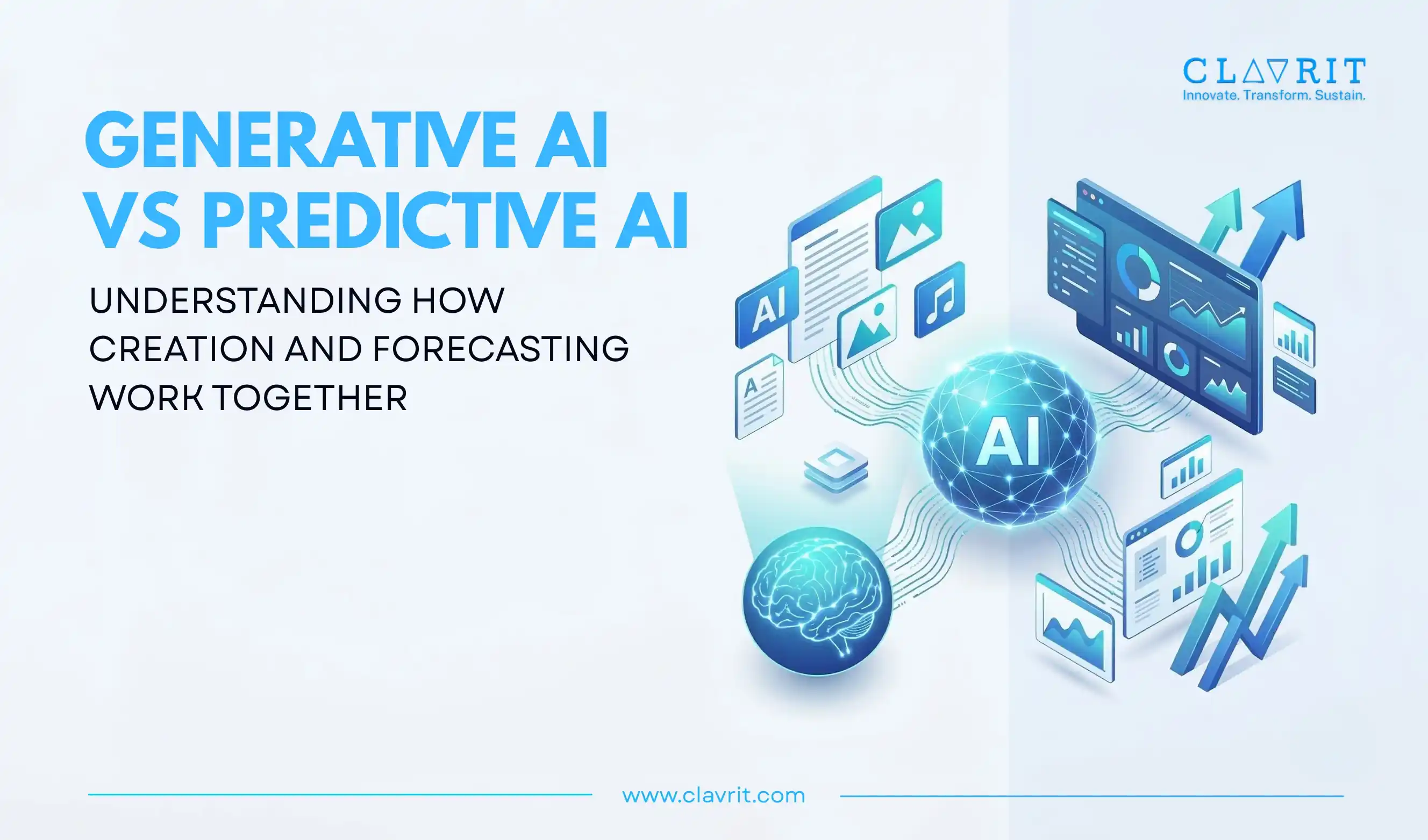
If you've been trying to wrap your head around generative AI vs predictive AI, you're not alone. These two branches of artificial intelligence get mixed up all the time - and it's easy to see why.
Both rely on machine learning. Both process large amounts of data. But their goals are completely different. One creates new things. The other helps you anticipate what's coming.
Here's a plain-English breakdown - with real examples of how each one works and why businesses are starting to use them together.
What Is Generative AI?
Generative AI refers to systems that produce new content — text, images, code, audio — based on patterns learned from training data. It doesn't search or retrieve. It actually creates.
Popular tools like ChatGPT, Midjourney, and GitHub Copilot are all built on generative models such as Large Language Models (LLMs) and Diffusion Models.
Things it can produce:
- Blog posts, product descriptions, and marketing copy
- Images, graphics, and design concepts
- Software code and auto-generated documentation
- Audio clips and synthetic video content
The core value? It scales creative output without scaling your headcount.
What Is Predictive AI?
Predictive AI taps into past information to provide insight into what may occur in the future. Rather than generating new data, the same tool gives your team the insights necessary to take action before an issue or opportunity arises by predicting future outcomes rather than creating them based upon historical data.
It identifies past patterns through several separate techniques such as regression analysis, decision trees, and neural networks to identify patterns in previous records that allow for an action to be taken prior to a problem or opportunity presenting itself based upon the outcome of the future.
Some examples of ways that predictive AI can be used include
- Anticipate how consumers will purchase or stop buying
- Predict what our sales will look like or when our seasonal demand will occur
- Identify and eliminate fraudulent transactions during real-time
- Plan to replace equipment before downtime occurs as a result of failure
- Optimize our inventory towards meeting our supply chain
Ultimately, this type of AI application allows businesses to develop data-driven foresight based upon predictive models rather than relying on instinctive gut feelings while making their respective decisions.
What's the Difference Between Generative AI and Predictive AI?
Generative AI vs Predictive AI: Head-to-Head Comparison
Same foundation. Very different purpose. Here is exactly how they differ across every key dimension.
| Generative AI | Predictive AI | |
| Core Purpose | Creates new content and outputs | Forecasts future outcomes and behaviours |
| Output Type | Text, images, code, audio, video | Predictions, risk scores, demand forecasts, trend reports |
| Data Usage | Learns patterns to produce something brand new | Analyses past data to project what comes next |
| Technology | LLMs, diffusion models, GANs, transformers | Regression models, decision trees, neural networks |
| Best For | Automating creative and content-heavy tasks | Planning, risk reduction, and data-driven decisions |
| Business Impact | Scales output, reduces manual creative work | Sharpens strategy, improves accuracy, cuts risk |
Generative AI Use Cases
Generative AI is already reshaping how teams work across multiple functions:
- Content marketing — produce blogs, email campaigns, and ad copy at speed
- Software development — autocomplete code, write tests, generate documentation
- Product design — rapidly prototype visual concepts and creative directions
- Customer support — deploy chatbots that give personalised, context-aware replies
- E-learning — generate course content, quizzes, and training materials automatically
The result is more output, faster turnaround, and fewer repetitive tasks for your team.
Predictive AI Use Cases
As industries increasingly turn to predictive Artificial Intelligence as a decision support tool, predictive analysis has emerged as a key player in this trend as it allows users to predict future events by using information from prior trends and patterns. Predictive intelligence (PI) plays a critical role in:
- Retail: It provides the opportunity to anticipate customer demands to prevent inadequate supply and/or overstocking.
- Finance: It can assist in identifying unusual transaction patterns or behaviours, thereby identifying potential instances of fraud.
- Healthcare: It can be used to identify patients that may need to be readmitted and help hospitals manage their resources more effectively by tracking the average length of stay for given procedures.
- Manufacturing: It can help facilitate effective scheduling of preventative maintenance on equipment before it fails, therefore preventing lost production due to unexpected repairs.
- Software as a Service (SaaS): It can identify customers that are likely to discontinue their business with a vendor and as a result, trigger proactive means of handling those customers to keep them.
Thus, for a large number of industries and businesses, predictive intelligence is not a choice but rather, an integral operational requirement.
How Generative AI and Predictive AI Can Power Your Business
Here's where the real competitive advantage lies. When you combine both technologies, you move beyond knowing what's likely to happen - you automatically do something about it.
Practical examples:
- Predictive AI flags customers at churn risk : generative AI writes them a personalised retention email automatically
- Predictive AI forecasts a demand spike for a product : generative AI builds the promotional campaign content to match
- Predictive AI scores your highest-value leads : generative AI creates tailored outreach messages for each segment
That loop - predict, then create - is what separates reactive businesses from proactive ones. Companies already running this combined approach are seeing measurable gains in retention, revenue, and operational efficiency.
If you're building an AI strategy for your business, understanding how these two types of machine intelligence complement each other is the right place to start.
Frequently Asked Questions
Q1. What is the main difference between generative AI and predictive AI?
Generative AI creates new content like text, images, and code. Predictive AI analyses historical data to forecast future outcomes. One builds things; the other anticipates them.
Q2. When should a business use generative AI instead of predictive AI?
Use generative AI when you need to automate content creation or scale creative output. Use predictive AI when you need to forecast trends, manage risk, or make data-driven decisions. Many businesses get the best results by using both.
Q3. Can generative AI and predictive AI work together?
Yes — and that combination is increasingly common. Predictive models identify patterns or opportunities, and generative systems act on them automatically. Together they turn insight into action without manual steps in between.
Q4. Which industries benefit most from predictive AI?
Finance, retail, healthcare, and manufacturing lead adoption. These sectors rely on accurate forecasting for fraud detection, inventory management, patient care, and equipment uptime.
Q5. Why does understanding generative AI vs predictive AI matter for businesses?
Choosing the wrong tool for the wrong problem wastes budget and delays results. Knowing the difference helps you build an AI strategy that's aligned with your actual business goals — whether that's automating content, improving forecasts, or doing both.