An enterprise AI roadmap is the differentiation marker between organizations that generate genuine value through AI and those that are simply wasting a huge amount of money conducting unsuccessful pilot projects. According to the McKinsey state of AI report, published in November 2025, 88% of organizations are now using AI for at least one business function but only 39% are able to see measurable results.
The difference between adoption and value is not an issue bound with technology. It is an issue bound with sequence and planning problems. An effective organization AI roadmap brings your organization an organized way from experiments to an overall rollout plan.
Why Most Enterprise AI Initiatives Stall
Data provided by S&P Global shows that over 42% of businesses scrapped most of their AI projects in 2025, which is much higher than the previous year’s figure of 17%. The reason for such a drastic decision is not the fact that AI didn’t bring the expected results; rather, the companies began implementing their projects without drafting purpose and defining follow-up actions.
The three main causes are the same across all major studies: poor data quality, weak governance, and inability to go from pilot projects to production. A structured AI roadmap for enterprises addresses all three before they derail your investment.
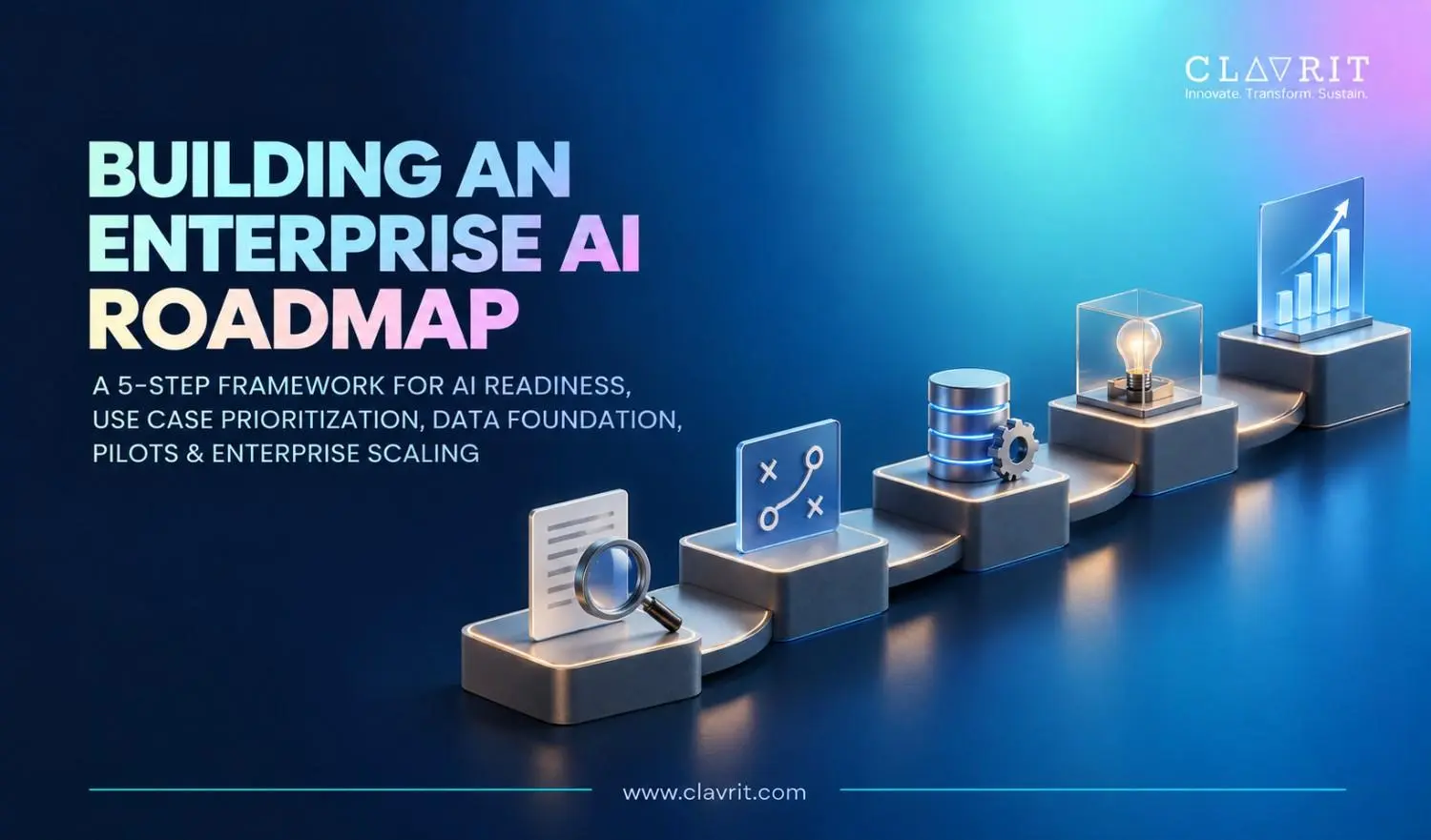
The 5-Step Enterprise AI Roadmap Framework
Step 1: Assess AI Readiness Honestly
The initial step in any corporate AI strategy is the candid evaluation of the current position of your company regarding various relevant factors. There are four aspects to take into consideration during this evaluation: the analysis of the data maturity level, infrastructure readiness, organizational capability, and current usage of AI technologies, including Shadow AI, which is employed in specific units of the organization.
Step 2: Define Business Outcomes and Prioritize Use Cases
An AI strategy produced without taking business data into account will lead to a failure of the strategy. AI investment must be oriented towards solving particular business problems.
Step 3: Build Your Data and Infrastructure Foundation
Data preparation is not just a preparatory stage, but rather a starting point that is everything is built on. The existing problems with data quality significantly impact more than 99% of AI and ML projects, which is an expensive process for companies with an annual bill of $12,900,000 on average according to Promethium AI’s benchmark survey for 2025.
Step 4: Execute Pilots and Validate Before Scaling
Run your first use cases as structured pilots with defined success metrics, a human review step for AI outputs, and clear gate criteria that must be met before scaling begins. Purchased AI solutions succeed roughly 67% of the time versus 22% for internal builds, according to MIT NANDA 2025. The build vs. buy decision at this stage is one of the highest-leverage choices in the entire enterprise AI roadmap.
Step 5: Scale With Governance Built In
Moving from successful pilot to enterprise-wide deployment is where most organizations stall. Only 16% of AI initiatives have successfully scaled across the enterprise, according to IBM Institute for Business Value 2025.
How Clavrit Builds Your Enterprise AI Roadmap
Clavrit's AI Onboarding Packages give enterprises a structured path from AI assessment to production deployment:
AI readiness assessment : genuine evaluation of data maturity, infrastructure and organizational capability before budget allocation.
Use case prioritization : Outline key applications of AI with the highest ROI for your organization.
Data foundation design : governance, integration, and pipeline structure which increases the efficiency of all AI initiatives.
Pilot execution and validation : well-defined pilots with specific success gates which minimize risk prior to investment.
Governance framework : compliance-ready governance designed at the very beginning.
Scale and optimization : complete support from the pilot to the implementation into enterprise systems.
Conclusion
An enterprise artificial intelligence roadmap is not a deck of presentation slides, it is the plan of action that decides if your investment in AI will yield results or be part of the other 42% of initiatives lying idle in 2025.
The five stages of successful use of AI in the enterprises are readiness assessment, defining the outcomes to be achieved, developing the data foundation, conducting the pilot, and scaling the technology using a set of regulations. Even though the technology itself is accessible to everybody, the correct technique for exploiting it is what distinguishes the leaders in the market.
Ready to build an enterprise AI roadmap that reaches production? Explore AI Onboarding Packages →
FAQs
1. What is an enterprise AI roadmap?
An enterprise AI roadmap consists of a phased approach to achieving AI investments that align with business results. They typically consist of readiness assessment, use cases prioritization, data foundation, pilot execution, and scalable governance. It differentiates the companies that derive measurable value from AI from the ones stuck in piloting.
2. How long does it take to execute an enterprise AI roadmap?
Foundations and strategy take 4 to 12 weeks. Pilot execution takes 3 to 6 months. Enterprise-wide scaling consistently takes 12 to 24 months when done correctly. Organizations that rush data preparation and governance trying to compress this timeline account for the majority of AI initiatives that stall or get abandoned.
3. What is the most common reason enterprise AI roadmaps fail?
Poor data quality is the leading failure cause affecting 99% of AI and ML projects and costing $12.9 million annually per organization on average. The second most common cause is weak governance not built into the roadmap from the start. Both are addressable with proper planning before deployment begins.