Digital transformation has become a business priority for enterprises looking to improve operations, deliver better customer experiences, and stay competitive in changing markets. From modernising legacy systems to integrating artificial intelligence (AI), businesses are rethinking how technology supports their long-term goals.
However, digital transformation involves more than adopting new tools. Enterprises must understand their existing challenges, choose the right technologies, integrate them with current systems, and ensure employees can use them effectively. Without a clear strategy, even significant technology investments can struggle to deliver the expected results.
This is where a digital transformation solution provider becomes important. The right partner helps businesses connect technology investments with measurable business objectives, manage implementation challenges, and build systems that can evolve as their needs change.
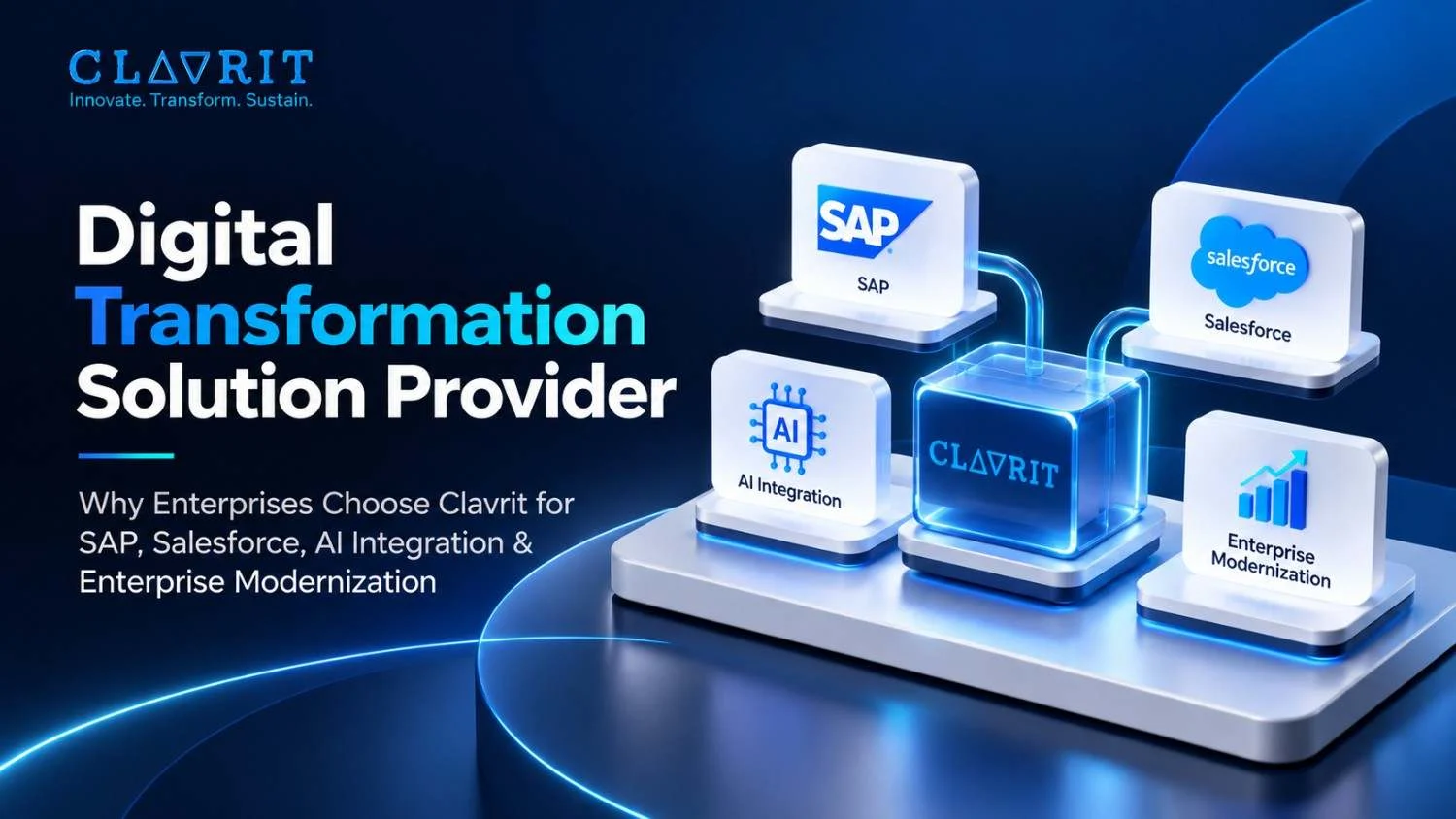
Clavrit Digital Solutions supports enterprises through technologies and services spanning SAP, Salesforce, AI and machine learning, enterprise application development, data analytics, and IT services. Its approach brings technology expertise and business requirements together to help organisations move from transformation planning to implementation and ongoing optimisation.
What Does a Digital Transformation Solution Provider Do?
A digital transformation solution provider helps organisations use technology to improve business processes, modernise systems, and create new capabilities.
Rather than focusing on a single software product, a transformation partner considers how different technologies, applications, data sources, and workflows work together across an organisation.
Its responsibilities can include:
Digital transformation strategy: Assessing existing systems, identifying process gaps, and defining technology priorities.
Enterprise system modernisation: Upgrading, migrating, or improving legacy applications and business platforms.
AI and intelligent automation: Identifying suitable opportunities to automate repetitive work and improve decision-making.
Enterprise software implementation: Configuring and integrating platforms such as SAP and Salesforce.
Custom application development: Building applications around specific business requirements.
Data and analytics: Helping businesses use operational and customer data more effectively.
Ongoing IT support: Maintaining, monitoring, and optimising systems after implementation.
The exact scope depends on the organisation's objectives, existing technology environment, budget, and internal capabilities.
A reliable provider does not recommend technology simply because it is new. It first understands the business problem and then identifies the solution that makes the most sense.
Why Enterprises Need a Digital Transformation Partner
Digital transformation becomes more complicated as organisations grow. Different departments may rely on separate applications, data may be distributed across multiple systems, and older platforms may not integrate easily with newer technologies.
A transformation partner helps address these challenges in a structured way.
1. Connecting Technology With Business Goals
Technology investments should support specific business outcomes, such as improving customer service, reducing manual processes, increasing operational visibility, or simplifying internal workflows.
A digital transformation partner helps translate these objectives into an implementation roadmap. This gives teams a clearer understanding of what needs to change, why it matters, and how progress will be measured.
2. Integrating Disconnected Systems
Many enterprises use different platforms for finance, customer relationship management, supply chain operations, analytics, and internal communication.
When these systems operate in isolation, employees may need to enter the same information multiple times or rely on manual processes to transfer data.
Integration can improve information flow between applications, reduce repetitive work, and provide teams with more consistent data for decision-making.
3. Modernising Legacy Infrastructure
Legacy systems may continue to support important business functions, but they can become difficult to maintain, extend, or integrate.
The objective is not to change everything at once. It is to develop a practical modernisation strategy that considers business continuity, technical dependencies, and long-term requirements.
4. Adopting AI and Automation Responsibly
AI can support tasks such as information analysis, workflow automation, forecasting, and customer service. However, its value depends on factors including data quality, process design, security, and the suitability of the use case.
An experienced partner helps organisations identify where AI can solve a genuine problem, assess implementation requirements, and establish appropriate monitoring and governance.
This helps businesses approach AI as part of a broader transformation strategy rather than treating it as an isolated technology initiative.
5. Supporting Long-Term Scalability
Business requirements change as companies enter new markets, add customers, expand operations, and introduce new services.
A well-planned technology environment should accommodate these changes without requiring major redevelopment every time a new requirement emerges.
A transformation partner considers future integration needs, application architecture, system performance, and ongoing maintenance during implementation.
What to Look for in Top Digital Transformation Companies
When evaluating top digital transformation companies, enterprises should look beyond brand recognition, technology partnerships, or the number of services listed on a website.
The more important question is whether a provider can understand the organisation's needs and deliver a solution that works in its actual business environment.
Here are six factors worth evaluating.
1. Relevant Technical Expertise
Look for experience in the technologies that match your requirements.
For example, an enterprise modernising its customer experience platform may need SAP CX or Salesforce expertise. A company exploring intelligent automation may require AI engineering, data analytics, and application integration capabilities.
A broad service portfolio is useful, but relevant implementation experience matters more than the number of technologies a provider claims to support.
2. A Business-First Approach
A strong transformation partner starts by understanding existing processes, operational challenges, and business priorities.
It should be able to explain why a proposed solution is appropriate, what limitations to expect, and how success will be measured.
Be cautious of recommendations that focus heavily on tools without clearly connecting them to business outcomes.
3. End-to-End Implementation Capabilities
Digital transformation rarely ends when a system goes live.
Organisations may need help with architecture, development, migration, integration, testing, employee training, maintenance, and optimisation.
Choosing a partner that can support several stages of this lifecycle can improve continuity between planning and execution. It also helps establish clearer accountability for implementation and ongoing support.
4. Integration and Customisation Skills
Enterprise environments are rarely identical. Businesses have different workflows, reporting requirements, existing applications, and compliance obligations.
A suitable provider should understand how to configure standard platforms, build custom functionality where necessary, and connect systems without introducing unnecessary complexity.
The goal is to make technology work with business processes while avoiding excessive customisation that becomes difficult to maintain.
5. Security and Governance Awareness
Digital transformation often involves sensitive customer information, financial records, operational data, and business-critical applications.
Ask how the provider approaches access controls, data protection, testing, system monitoring, and relevant compliance requirements.
The exact controls will depend on the industry, technology stack, and regulatory environment. These requirements should be discussed before implementation begins, not after deployment.
6. Transparent Communication and Ongoing Support
Transformation projects involve changing requirements, technical dependencies, and implementation decisions.
A good partner communicates progress clearly, documents important decisions, identifies risks early, and explains how scope changes may affect timelines and costs.
Post-deployment support is equally important. Enterprises should understand who will maintain the solution, how issues will be handled, and what ongoing optimisation will involve.
Checklist: How to Choose a Digital Transformation Partner
Before selecting a provider, use this checklist to compare potential partners against your organisation's needs.
Business alignment
Does the provider understand our business objectives and operational challenges?
Can it explain how the proposed solution supports measurable outcomes?
Is there a clear implementation roadmap?
Technical capability
Does the team have relevant experience with our required platforms and technologies?
Can it integrate with our existing systems?
Can it support custom development or modernisation where required?
Delivery and implementation
Are project responsibilities, milestones, and deliverables clearly defined?
How will testing, migration, and deployment be managed?
What happens if requirements change during implementation?
Security and governance
Are data protection and access-control requirements understood?
Are relevant compliance obligations addressed?
How will system performance and reliability be monitored?
Long-term partnership
Is post-deployment support available?
Can the solution evolve as our business grows?
Are costs, dependencies, and support responsibilities transparent?
The right partner is one whose capabilities, working approach, and delivery model fit your requirements.
Digital Transformation Services and Solutions: What Enterprises Need
Digital transformation can involve several connected services. The right combination depends on an organisation's current technology environment and the outcomes it wants to achieve.
Clavrit brings together expertise across enterprise platforms, AI, custom development, and IT services to support different transformation requirements.
SAP Solutions
SAP platforms support important enterprise processes, including commerce, customer experience, and core business operations.
SAP-related transformation may involve implementation, upgrades, migration, configuration, integration, or ongoing optimisation.
Clavrit provides SAP-related services, including SAP CX solutions, SAP Commerce, and SAP Customer Data Cloud capabilities. These services can help organisations modernise their enterprise platforms and improve how business systems support customer and operational requirements.
Salesforce Services
Salesforce supports customer relationship management, sales operations, service processes, and workflow automation.
A transformation initiative may involve implementing Salesforce, improving an existing CRM environment, integrating customer data, or configuring workflows around business needs.
Clavrit's Salesforce services support organisations looking to improve CRM capabilities and connect customer-facing processes with their wider technology environment.
AI and Machine Learning
AI and machine learning can help enterprises analyse data, automate defined workflows, and develop new application capabilities.
However, successful implementation requires more than selecting a model. Organisations must consider data readiness, integration, security, evaluation, and how AI-generated outputs will be monitored.
Clavrit offers AI-related services covering implementation and integration, alongside work involving machine learning and intelligent applications. These capabilities can support organisations exploring practical AI use cases within their existing business systems.
Custom Enterprise Application Development
Standard software may not cover every business requirement. In these cases, custom application development can help address specific workflows, integration needs, or operational challenges.
This may include building enterprise applications, developing web and mobile solutions, integrating third-party services, and improving existing software.
Clavrit's custom development capabilities help businesses explore solutions tailored to their requirements while considering scalability and integration with existing systems.
Data Analytics and Integration
Data becomes more useful when it is accessible, consistent, and relevant to the decisions employees need to make.
Data and analytics initiatives can involve connecting information sources, improving data flows, developing reporting capabilities, and enabling more informed operational decisions.
These initiatives can also support AI adoption by helping organisations establish the data foundations needed for reliable applications.
Managed IT Services and Ongoing Optimisation
After a transformation project goes live, systems still require maintenance, monitoring, troubleshooting, and periodic improvements.
Managed IT services can help organisations maintain their technology environment while allowing internal teams to focus on business priorities.
Clavrit also provides IT services and support capabilities that can contribute to the ongoing management and optimisation of enterprise systems.
Why Choose Clavrit as Your Digital Transformation Partner?
Clavrit Digital Solutions brings together enterprise technology expertise and implementation capabilities across SAP, Salesforce, AI, machine learning, and custom application development.
This combination is relevant for organisations whose transformation requirements extend across multiple systems rather than a single software platform.
Solutions Aligned With Business Requirements
Every organisation has different priorities. Some need to modernise enterprise applications, while others want to improve customer experiences, connect business systems, or explore AI-driven workflows.
Clavrit's capabilities span these areas, allowing businesses to evaluate solutions based on their specific requirements.
Expertise Across Enterprise Technologies
Transformation initiatives often involve several connected technologies. Experience across SAP, Salesforce, AI, and enterprise applications can help organisations consider integration requirements alongside individual platform needs.
Support Beyond Initial Implementation
Implementation is one stage of a longer process. Testing, maintenance, troubleshooting, and optimisation all influence how effectively a solution performs over time.
Clavrit's service portfolio includes implementation and ongoing IT support capabilities to help businesses manage their technology environments beyond initial deployment.
A Focus on Practical Business Outcomes
The purpose of digital transformation is to improve how an organisation operates.
By starting with business challenges and identifying the technologies and services that address them, enterprises can build a more focused transformation roadmap instead of adopting tools without a clear objective.
Conclusion
Choosing a digital transformation solution provider is a strategic decision that can influence how an enterprise modernises its systems, integrates information, adopts AI, and prepares for future growth.
The strongest partnerships combine technical expertise with business understanding, clear implementation planning, integration capabilities, and ongoing support. They also recognise that transformation is a continuing process rather than a one-time technology upgrade.
Clavrit brings together SAP, Salesforce, AI, custom development, data analytics, and IT services to support enterprises with different transformation requirements.
For businesses evaluating their next technology initiative, the starting point should be clear: identify the problem, define the desired outcome, and choose a partner whose capabilities match the journey ahead.
Looking to plan your next digital transformation initiative? Explore Clavrit's enterprise technology and digital transformation services to identify the right approach for your business.
FAQ's
1. What is a digital transformation solution provider?
A digital transformation solution provider helps organisations modernise systems, improve workflows, integrate applications, and adopt technologies such as AI, cloud platforms, and enterprise software to support business objectives.
2. How do I choose the right digital transformation partner?
Evaluate technical expertise, relevant project experience, business alignment, integration capabilities, security practices, implementation methodology, and post-deployment support. The right partner should understand your requirements and explain how its proposed approach will address them.
3. What services are included in digital transformation?
Services may include transformation strategy, enterprise software implementation, legacy system modernisation, AI integration, custom application development, data analytics, system integration, and managed IT services. The exact combination depends on business requirements.
4. Why is digital transformation important for enterprises?
Digital transformation can help enterprises streamline operations, connect business systems, improve access to information, support better decision-making, and create more adaptable technology environments. Results depend on implementation quality, employee adoption, and alignment with business objectives.
5. Why consider Clavrit for digital transformation?
Clavrit offers capabilities across SAP, Salesforce, AI and machine learning, enterprise application development, data analytics, and IT services. These capabilities can support businesses evaluating enterprise technology modernisation and integration initiatives.