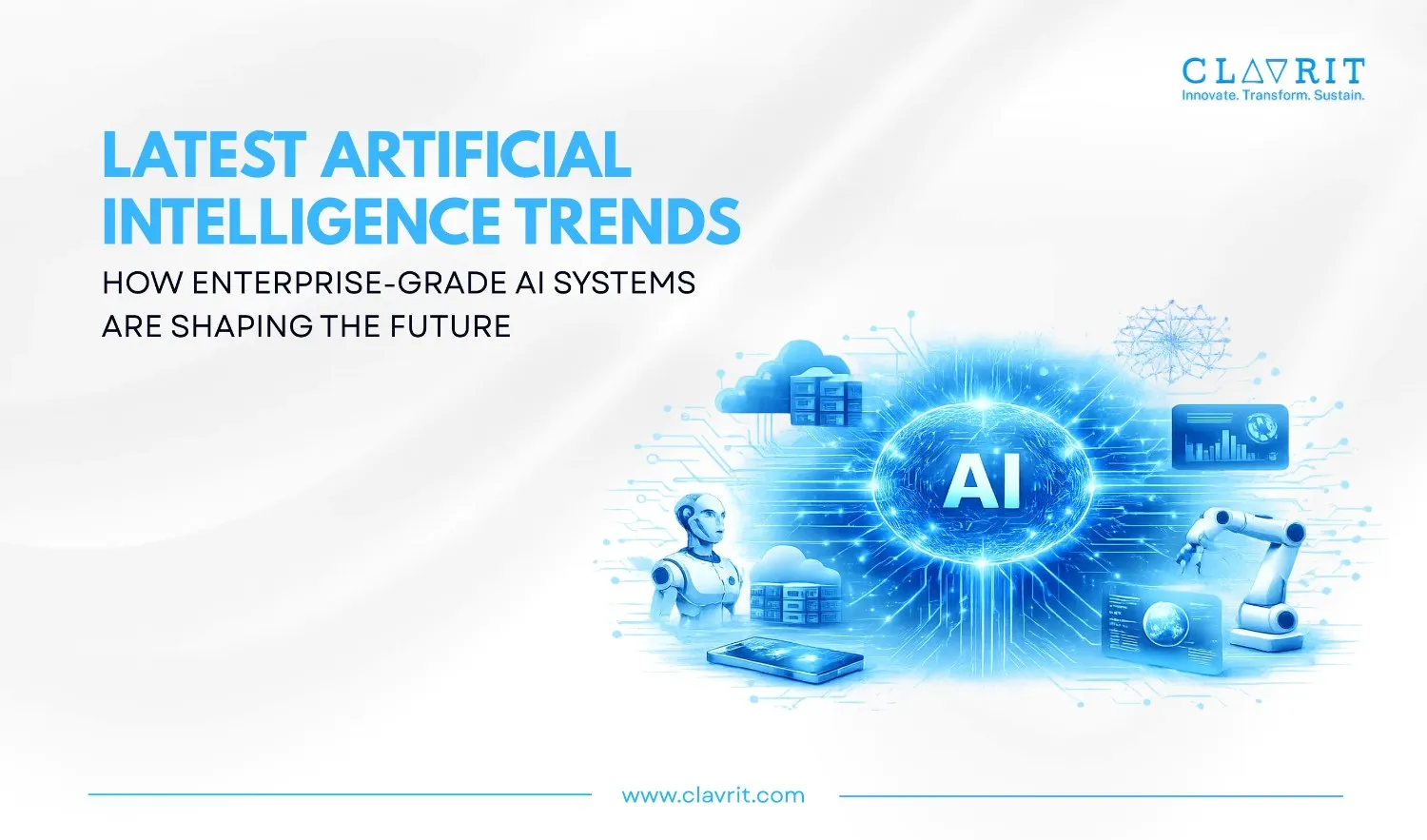
In recent years, Artificial Intelligence has evolved from the experimental phase to innovations in numerous enterprises, and is now part of the core of digital platform designs (systems), decision-making and scaling. The ongoing acceleration in using AI creates a new challenge as companies no longer have to ask whether they should use AI or not but what type of AI systems to use that are reliable, governable and ready for use in a production environment.
We see evidence of this dramatic shift in the recent trends in Artificial Intelligence. New technologies typically using AI are no longer primarily focused on AI models or novelties, but rather focus on system architecture, data engineering, lifecycle management and trust. It is imperative that companies understand these trends so they are able to avoid having their pilots fail to launch and build AI systems that will be scalable to their business's complexities.
The future of Artificial Intelligence will be determined not by the smartest algorithms alone, but by how well AI is integrated into a company's enterprise systems, business processes and decision-making framework.
AI Is Transitioning from Experimental Models to Enterprise-Grade Systems
Shifting towards an end-to-end AI systems Engineering approach rather than developing isolated models is becoming one of the key trends for AI in the future. When AI was first being developed, early AI implementations were centred on developing high-quality models from highly curated and stable environments. In contrast, enterprises are now developing and evolving their AI solutions as part of distributed production Channels – or systems – due to the fact that their AI solutions will now integrate directly with APIs, data pipelines, user- facing applications, and operational workflows.
This shift to distributed production systems and not just isolated model development has brought into the spotlight many system level issues such as inference latencies (i.e., how long does it take for a machine learning (ML) model to make a prediction), throughput, fault tolerance, and graceful degradation.
Many enterprise AI models are also deployed as microservices, with each model being horizontally scaled and consistently monitored. Due to this shift from isolated model development to distributed production systems, the future of AI will increasingly be about architecture decisions and not just about the algorithms used in the development of the model.
Data-Centric AI and Feature Engineering at Scale
Emerging AI technologies are driving a move away from model-centric optimization toward data-centric AI. Organizations are starting to understand that building consistent feature definitions, acquiring quality labelled datasets and developing strong data pipelines generally contribute to a model’s ability to deliver improved results more than doing incremental improvements in the model will.
As businesses are adopting the increase in the use of AI, they are also putting in place common shared features store and version control for data and data lineage as core components to their AI infrastructure.
Additionally, it will be necessary to create a consistent feature set within the different environments in which model training and inference are performed; if this isn't achieved the model will perform well during the initial development stage but will continue to decline when transitioned into production.
As such, there has been a clear movement toward tying an organization’s ability to achieve an AI-based objective directly to their ability to build and manage a well-engineered data layer.
Real-Time and Event-Driven AI Architectures
Another defining AI trend is the move toward real-time inference and event-driven architectures. Batch processing models haven't shown to be effective for scenarios Real- Time Data: fraud detection, pricing that changes, optimizing the movement of goods, and customizing the experience for the customer.
From a technical point of view, this means building AI systems that can accept a stream of data in real time, make an inference (decision) with low-latency, and place that inference into downstream systems immediately. Along with this, it adds state management, concurrency and consistency issues with/in distributed services. Consequently, emerging AI technologies are being built with the expectation that they will be built to meet the needs of real-time systems rather than experimental, off-line systems.
Going forward in AI there will be as much pressure to respond, timely, as there will be for accuracy.
MLOps as a Core Engineering Discipline
As AI systems scale, MLOps has become a foundational capability rather than an optional practice. Through developing formalized model lifecycle management processes using automated training pipelines, continuous integration and continuous delivery of models (CI/CD) and production monitoring.
Mature AI environments regularly implement techniques such as shadow deployments, canary releases, automated rollback, and continuous retraining of models.
To ensure your AI models are credible and trustworthy over time, they need to be continuously monitored for model drift, data drift, and concept drift.
Your AI systems are exposed to possible corruption and deterioration as time goes on if you do not follow the principles of MLOps (machine learning/operations); however, operationalising your AI system is now considered one of the top three emerging technologies in regards to AI.
Governance, Explainability, and Trust Built into Architecture
AI governance is now not just being done via documentation but it's beginning to be built-in to the design of systems. As a result, there is a growing emphasis on including layers of explainability, decision logs, audit trails, and access controls as part of an AI pipeline.
There is regulatory pressure driving this trend, but there is also operational risk as well which can lead to a need to create relationships or trust with customers and producers in modern-day AI systems through their architecture rather than their intent. Enterprises will need to understand how they arrived at a decision, what data was used to arrive at that decision and how they can repeat them.
Case Study: Netflix and AI at Enterprise Scale
A well-documented example of these AI trends in practice is Netflix, which has built AI into the core of its distributed systems rather than treating it as a standalone capability.
Netflix utilizes Artificial Intelligence heavily across its functions such as personalization, identifying and recommending content, optimizing streaming quality and managing its data centres’ capacity. The relevance of Netflix’s approach is not intrinsically due to the sophistication of the individual models that are deployed, rather it results from the manner in which AI is embedded within a highly distributed, real-time architecture. Models are consuming continuously flowing streams of user behaviour data, producing predictions at scale and providing results back into recommendations/delivery systems for users.
The overarching lesson learned from Netflix is that attaining success with AI in enterprises is largely based on architecture (how AI functions like an ecosystem), data flow and life cycle management as opposed to solely possessing sophisticated algorithms.
AI-Augmented Decision Systems Over Fully Autonomous AI
Another emerging trend shaping the future of artificial intelligence is the rise of AI- augmented decision systems. Companies are using AI to enhance human decision-making by using it to provide forecasts, probability distributions, and scenario analysis in place of completely autonomous intelligence.
These systems combine predictive models with business rules, constraints, and feedback loops. By using this hybrid model of decision-making, decision quality is improved while still allowing for human control, which is particularly critical in high-risk or regulated environments. In this way, AI acts as an additional source of skill, rather than as a substitute for human ability.
How Clavrit Helps Enterprises Operationalize AI Trends
At Clavrit, artificial intelligence is approached as a systems engineering challenge. Clavrit helps enterprises design AI architectures that integrate data pipelines, inference services, monitoring, governance, and security into a cohesive production environment.
By aligning emerging AI technologies with enterprise platforms and operational workflows, Clavrit enables organizations to move from experimental models to production-grade AI systems that are scalable, observable, and compliant.
Conclusion
Artificial intelligence trends are changing from isolated innovation to establishing reliable governed scalable AIs in a realm of real-world constraints.
The maturation of new AI technologies means that companies that invest in their architecture, their data management, and their lifecycle management will be the ones who shape the future of artificial intelligence and will leave the others continuing to experiment.