Artificial Intelligence was originally seen as a concept for experimentation. However, as stated by IBM's Global AI Adoption Index, there is now widespread acceptance of AI usage by nearly all businesses with respect to incorporating AI technology into their daily business activities (decision automation, analytics, customer engagement) either through active use of, or trials involving, AI technologies.
Although AI adoption is increasing, many organizations find it difficult to convert their understanding of the conceptual view of AI into actual implementation in an organization. Most beginning users of AI will have difficulty understanding how to utilize AI in practice, and will find that the majority of their gaps in knowledge are more related to the way that AI operates within a company's environment rather than how it is defined.
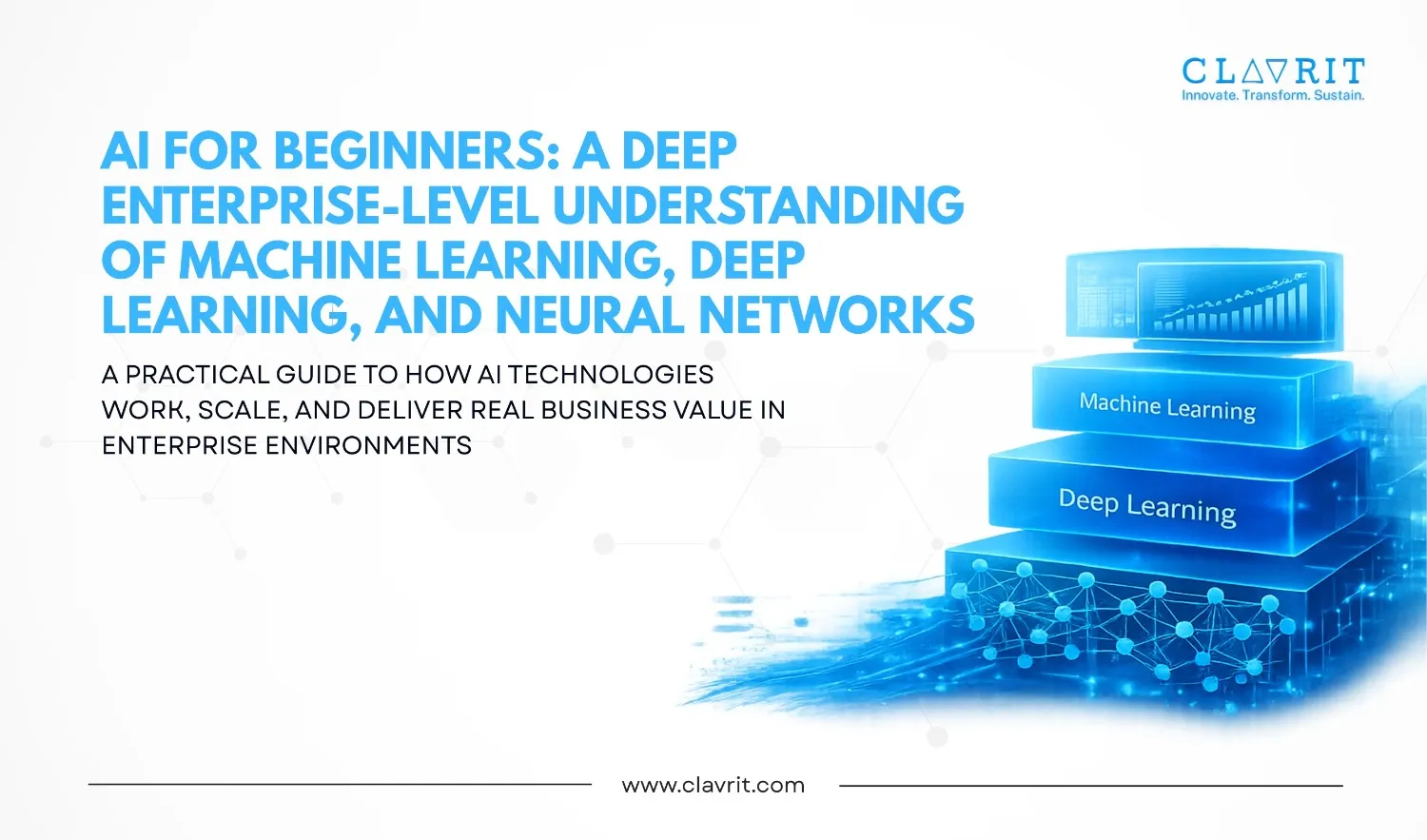
This article will review Machine Learning (ML), Deep Learning (DL), and Neural Networks in terms of the technology, architecture, and operations. This will provide a foundation for new users of AI. New users of AI will understand how AI technologies are developed, deployed, and supported in production environments.
Enterprise Case Study: How Scalable AI Architecture Delivers Measurable Impact
The Global AI Adoption Index published by IBM states that businesses using actual, commercial-grade machine-learning systems to augment their previously conducted pilot- programs will see an increase in their operational efficiency of between twenty to thirty percent thanks to automating decision-making processes and optimizing workflows. The enterprise applications described in IBM's publications related to both the financial services sector as well as operational functions, include:
- Automating classification and risk-assessment workflows via machine-learning models.
- Using Deep Learning to process large quantities of unstructured data including transaction logs and documents.
- Implementing standardised MLOps to create digital pipelines for the construction of neural networks, with ongoing monitoring and retraining of the datasets.
IBM reports that enterprises following this architecture-driven AI approach achieved:
- Up to 40% reduction in manual processing effort, as ML replaced rule-based decision systems.
- Improved prediction accuracy by over 25% in data-rich classification and forecasting tasks.
- Faster deployment cycles, with model updates moving from weeks to days due to automated CI/CD pipelines.
This demonstrates that enterprise AI success depends not only on algorithms, but on how models are integrated, deployed, and governed at scale.
What AI Beginners Must Understand About Enterprise AI Architecture
In an enterprise environment, AI systems will be used alongside other technologies such as a cloud platform, Data Systems that are Distributed across multiple Locations and Automated Data Pipelines. A common cycle of an enterprise AI would be as follows:
- Ingest Data from various Sources
- Pre-process and Engineer Features
- Store Features to enable re-use and maintain Consistency
- Train and Validate Models
- Deploy and Infer
- Monitor and Continuously Improve through MLOps
According to Gartner, most AI projects that do not achieve lasting value will lose focus on Deployment, Monitoring and Governance instead of not having Accurate Models. This is an important factor for being successful with MLOps and hence the overall success of Enterprise AI.
Machine Learning: The Foundation of Enterprise AI
Machine Learning (ML) has enabled Contemporary AI systems to operate by providing the ability to "learn," as opposed to having to rely on rules established up front. Modern-day ML leverages historical data to develop its models, which are then used for making predictions and decisions.
At an enterprise level:
- ML models are trained through optimization algorithms (like Gradient Descent) to determine optimal values for their model parameters.
- Learning in ML is evaluated using 'Loss Functions', such as 'Mean Squared Error' or 'Cross Entropy Loss'.
- Processing of data occurs on both "Data Lakes" as well as "Data Warehouses."
- Workflow orchestration tools (such as Apache Airflow, Kubeflow, or Cloud-native Pipelines) allow for reproducibility and traceability of the workflow from inception to deployment.
As an entry-level person, you can think about ML in terms of how enterprises take a large volume of Structured & Unstructured Data and convert it into Predictive Insights that allow them to operate more efficiently while making better decisions.
Deep Learning: Extracting Value from Unstructured Data
Using multiple neural networks, deep learning represents a further refinement of traditional machine learning by enabling the development of artificial intelligence applications based on understanding complexities associated with raw, unstructured data inputs.
McKinsey has published several studies suggesting that deep learning systems are an important aspect in the advancement of enterprise uses for artificial intelligence. They (deep learning systems) are designed to:
- Learn automatically from unstructured, raw data.
- Be efficient by utilizing the capabilities of GPU technology and the ability of distributed training to scale.
- Process and analyze large volumes of complex data, i.e., textual, image and time-series.
Examples of enterprise applications of deep learning include document intelligence, anomaly detection, semantic searching, natural language processing and more.
Neural Networks: The Core Engine Behind AI Systems
Deep learning systems are based upon neural networks as their computational engine. Each layer mathematically modifies the incoming information via weighted sums and activation functions that enable the neural network to learn to identify nonlinear relationships.
The neural network will progressively adjust its internal parameters during learning through a process known as backpropagation. Enterprise scale networks may have hundreds of thousands to millions of trained parameters and will benefit from using various techniques, such as regularization, batch normalisation, and learning rate scheduling, to achieve training stability.
Neural networks provide numerous critical enterprise application solutions that include recommendation engines, demand prediction and forecasting, fraud detection, and predictive maintenance.
Why Infrastructure and Scaling Matter for AI Beginners
Many first-time users of artificial intelligence also note that there are vast differences between the performance of an AI model in a live environment as opposed to when it is being tested on a development machine. Google Cloud's Engineering team and various platform documentation have indicated that many AI projects are unable to transition from testing to an enterprise, or "live", environment for reasons including limited capacity to develop the infrastructure required to deploy these models, lack of scalability, and inadequate monitoring tools.
To build an enterprise-level AI solution requires:
- Distributed learning and reasoning
- Accelerated computing capabilities
- Centralised Feature Library
- Continuous integration and continuous delivery frameworks for deploying the models
- Real-time reasoning via API access
The performance of your AI model with respect to model drift, latency, and throughput, as well as the cost associated with operating an AI model are just as critical to an enterprise's success as the accuracy of the model itself.
How Clavrit Translates AI Knowledge into Enterprise Execution
Clavrit takes the knowledge base created by AI education and allows businesses to implement AI technology throughout all business units/projects in an organization.
Clavrit assists business in doing this by:
- Integrating AI workflows into an existing operational workflow
- Building cloud-native/scalable architecture
- Establishing reliable data engineering pipelines
- Deploying the models via APIs that have monitoring capability
- Supporting Governance, Compliance and Responsible AI
Clavrit acts as a bridge between having a conceptual understanding of AI and creating the actual production systems.
Conclusion
The success of AI for new entrants into this field isn't determined solely by theoretical concepts. The key to success is in being able to understand how artificial intelligence (AI) technologies such as machine learning and deep learning function within large enterprises on a scale that could potentially create significant value for the organization.
Through the application of technical fundamentals and sound architecture, infrastructure, and operation practices to AI, organizations have an opportunity to turn AI from a concept that is still being tested into something that can generate ongoing substantive benefits for the business.